
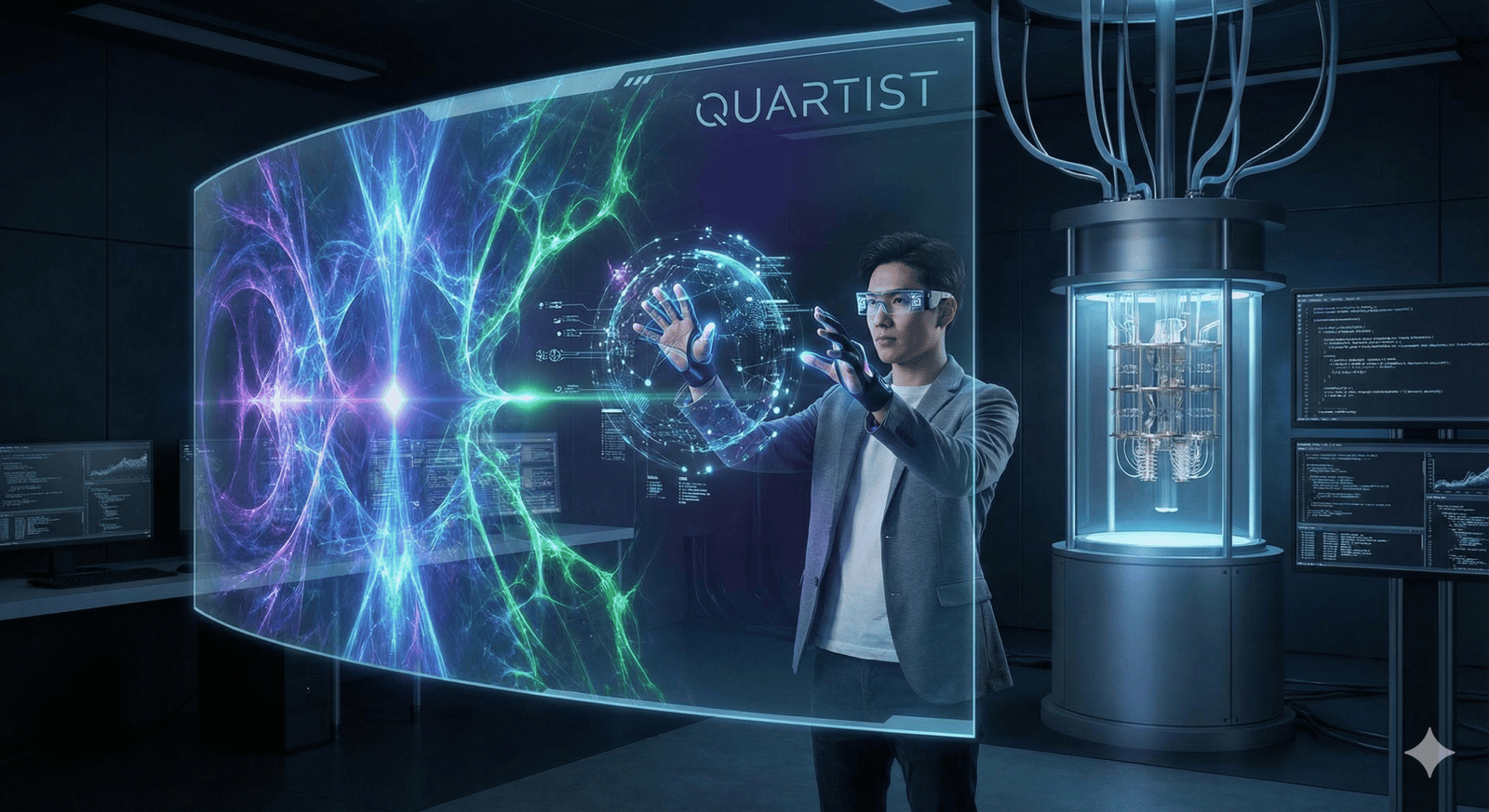
The creative world is standing on the precipice of a massive technological shift, one that makes the transition from physical paint to digital pixels look minor by comparison. We are entering the age of the Quartist. This emerging profession sits at the fascinating intersection of high-performance computing and abstract expressionism. It is not just about making pretty pictures; it is about visualizing the fundamental fabric of the universe using the most powerful machines humanity has ever built.
As artificial intelligence saturates the market with predictable imagery, the Quartist offers something radically different: art born from the true, unpredictable chaos of nature. This article explores why this niche is exploding, how it works, and why it represents the future of creative technology
Defining the New Creative Professional
A Quartist is a visionary who bridges the gap between quantum mechanics and visual arts. While a graphic designer manipulates pixels on a screen using established software, a Quartist manipulates qubits—quantum bits—using code.
They do not simply “draw”; they orchestrate complex mathematical probabilities. By writing algorithms that run on quantum processors, they generate visuals that are theoretically impossible to reproduce using standard classical computers.
The Limitations of Classical Digital Art
To understand the value of this new role, we must look at the limitations of current technology. Standard computers run on binary code—zeros and ones. This makes them deterministic. If you run the same code twice, you get the exact same result.
For artists seeking organic, chaotic, or truly random patterns, binary is a cage. It forces them to simulate randomness. A Quartist breaks free from this cage, accessing the non-binary nature of reality itself.
The Science Behind the Aesthetics
The magic lies in the physics. Quantum computers operate on the principles of quantum mechanics, specifically using subatomic particles. A Quartist leverages this to create “computational aesthetics.”
- Wave Functions: Using the mathematical waves of particles to generate flowing, organic visual lines.
- Interference: Crashing two data streams together to create unexpected, complex patterns.
Breaking the Binary Barrier with Qubits
The fundamental tool of the Quartist is the qubit. Unlike a bit, which is either off (0) or on (1), a qubit can represent a complex combination of both states simultaneously.
This allows the artist to explore a “solution space” that is exponentially larger than what a classical artist can access. A single image generated by a Quartist can contain more potential variations than there are atoms in the observable universe.
Superposition as a Design Element
One of the most exciting concepts a Quartist uses is Superposition. This is the ability of a quantum system to exist in multiple states at once until it is observed.
In design terms, this allows for the creation of “living” assets. Imagine a digital sculpture that changes its shape every time a user looks at it, not because of a random number generator, but because the underlying code is collapsing into a new reality each time.
Quantum Entanglement in Interactive Media
Entanglement is often described as “spooky action at a distance.” When two particles are entangled, changing one instantly changes the other, no matter how far apart they are.
A Quartist uses this for next-level connectivity. They can create digital installations across the globe that are synchronized not by the speed of the internet, but by the simulated laws of quantum physics, creating a profound sense of unity in their work.
The Essential Software Stack
You cannot find “Quantum Photoshop” on the shelf. The toolkit of a Quartist is technical and code-heavy.
- Qiskit (IBM): The most popular open-source framework for quantum coding.
- Cirq (Google): A library for writing quantum circuits.
- Python: The bridge language that connects the quantum code to visual libraries.
Quartist vs. Generative AI Prompter
It is crucial to distinguish this field from AI art. An AI prompter uses a neural network trained on existing images to predict what a picture should look like.
A Quartist does the opposite. They do not use training data. They use raw mathematical logic to discover images that have never existed before. One relies on the past (AI); the other explores the unknown future (Quantum).
Comparing Computational Creativity
Here is how the workflow differs between a traditional coder and a Quartist.
| Feature | Creative Coder (Classical) | Quartist (Quantum) |
| Logic Base | Boolean (True/False) | Quantum Logic (Probabilistic) |
| Randomness | Pseudo-Random (Simulated) | True Random (Nature-based) |
| Complexity | Linear Growth | Exponential Growth |
| Hardware | Standard CPU/GPU | Quantum Processing Unit (QPU) |
| Outcome | Deterministic | Probabilistic |
Why Big Tech is Hiring Artists
Tech giants are realizing that quantum data is too abstract for humans to understand intuitively. They need translators.
A Quartist serves as this translator. By turning complex qubit stability graphs into visual heatmaps or 3D structures, they help researchers “see” the data. This role is essentially “Quantum UX/UI,” making the invisible world visible.
The Hardware Barrier to Entry
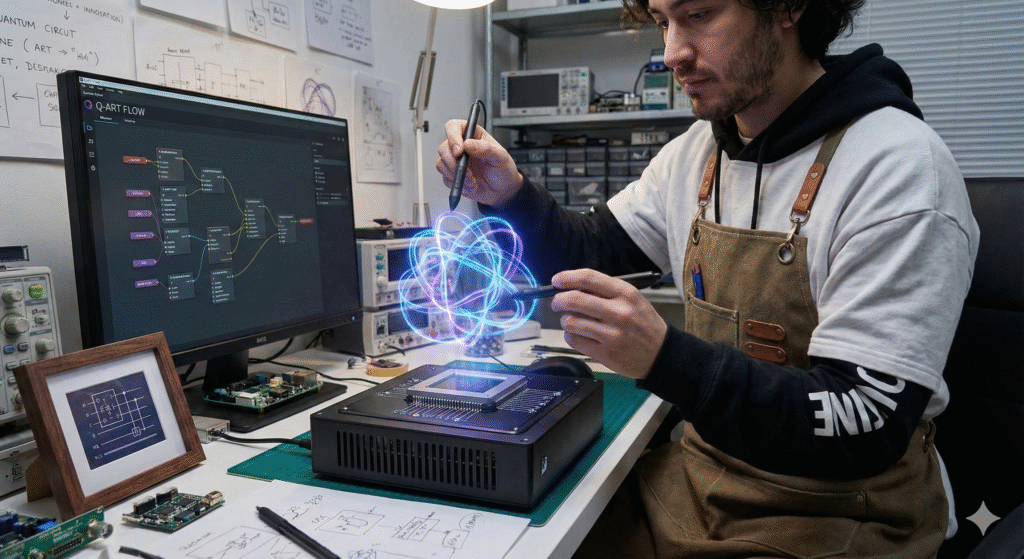
Do you need a million-dollar fridge in your office? No. The barrier to entry is knowledge, not hardware.
Almost all quantum art is created via the cloud. Companies like IBM and Rigetti offer cloud access to their quantum fleets. You write the code on your laptop, send it to the cloud, and the quantum computer processes the heavy lifting.
Monetization and the Art Market
The art world craves scarcity. Digital art has struggled with this because files can be copied.
However, a “Quantum-Generated” piece has a unique narrative. The fact that it was born from the specific collapse of a wave function gives it a “digital fingerprint” that collectors value. High-end NFT platforms are already seeing a surge in quantum-minted collections.
Educational Pathways for Beginners
There is no university degree for this specific niche yet. Most current professionals are self-taught hybrids of developers and artists.
- Learn Python: It is the language of the industry.
- Study Quantum Basics: Understand gates, circuits, and measurement.
- Visual Coding: Learn frameworks like Processing or TouchDesigner to render your data.
Challenges of the NISQ Era
We are currently in the “Noisy Intermediate-Scale Quantum” (NISQ) era. Quantum computers are noisy and prone to errors.
A skilled Quartist turns this bug into a feature. They embrace the “noise” as a texture, creating “Glitch Art” that is authentically derived from the instability of the machine. It is a visual representation of the current limitations of human technology.
The Philosophy of Authorship
This field raises deep philosophical questions. If the outcome of the art is determined by the probabilistic collapse of an atom, who is the artist?
The Quartist acts more like a gardener than a builder. They set the conditions, plant the seeds (algorithms), and nurture the environment, but the final bloom is determined by the laws of nature.
Future Applications in Gaming
The gaming industry is next. Procedural generation is used to create maps in games like Minecraft, but it can feel repetitive.
A Quartist could build a “Quantum Procedural Engine.” This would generate game worlds that are infinitely complex and non-repeating, creating unique experiences for every single player that are impossible to predict or replicate.
Building a Professional Portfolio
To get hired or sell work, you need proof of concept. A standard portfolio won’t cut it.
- GitHub Repository: Show your code. Prove you understand the circuits.
- Visual Gallery: High-resolution renders of your outputs.
- Case Studies: Explain the logic behind the art. “I used a Hadamard gate to create this gradient.”
Taking the First Step
The revolution is quiet, but it is happening. The Quartist is defining the aesthetic of the next century. By moving beyond the limitations of classical computing, these pioneers are painting with the building blocks of reality itself. If you love code, physics, and design, there has never been a more exciting time to start.
Frequently Asked Questions
What makes a Quartist different from a programmer?
While both write code, a programmer typically aims for efficiency and a specific, predictable output. A Quartist writes code to explore aesthetic possibilities and embraces unpredictability, often prioritizing visual impact over code efficiency.
Is this career path technically difficult?
Yes, it has a steep learning curve. You need to be comfortable with abstract mathematics and coding logic. However, you do not need to be a quantum physicist; you just need to understand the fundamental behaviors of qubits.
Can I use a normal computer to practice?
Absolutely. You can use “Quantum Simulators” which run on standard laptops. They simulate how a quantum computer would behave, allowing you to test your code and generate art without needing cloud access to a real QPU.
Is there a demand for Quartists right now?
The demand is niche but growing rapidly. Research institutions, tech marketing teams, and the high-end digital art market are the primary employers. As quantum technology becomes mainstream, the demand for visualizers will explode.
Does quantum art look different from normal digital art?
It often creates patterns that look “organic” or “fluid.” Because it mimics nature’s laws, the output tends to look more like biological structures, fluid dynamics, or starry nebulas, rather than the rigid geometry often seen in classical computer graphics.
How do I verify that art is truly quantum?
In the professional market, a Quartist will often provide the “Quantum Circuit” (the code) and the execution ID from the quantum computer used. This serves as a certificate of authenticity, proving the image came from a quantum processor.
Will AI replace the Quartist?
It is unlikely. AI works by recycling known data. A Quartist explores unknown mathematical possibilities. They are complementary technologies, and the most powerful creators will likely use both AI and Quantum computing together.