
Introduction
In the breathless pace of the modern digital landscape, we are witnessing a paradox: businesses have more tools than ever, yet they have less clarity on what their teams are actually capable of achieving. We are drowning in data but starving for insight. As a technologist who has spent the last decade optimizing workflows for high-growth startups, I realized that our current methods for measuring talent and technological utility are fundamentally broken. We rely on static resumes, outdated job descriptions, and productivity metrics that measure “busy work” rather than value. This disconnect is the driving force behind why I’m building Capabilisense.
Capabilisense is not just another project management tool or an HR dashboard; it is a dynamic capability sensing engine designed for the hybrid workforce of humans and Artificial Intelligence. The vision is simple yet radical: to move away from retrospective performance reviews and toward real-time capability mapping. By understanding the granular skills of a team and the specific utilities of their AI agents, we can orchestrate work with unprecedented efficiency. This article outlines the journey, the technical architecture, and the philosophy behind the platform, offering a window into how we plan to revolutionize the way the world understands work.
The Broken State of Talent Analytics
The genesis of Capabilisense began with a frustration that I believe many leaders share: the “Black Box” of team potential. Traditional talent analytics are historical artifacts. They tell you what an employee did three years ago at a different company, not what they are capable of learning or executing today with the aid of modern tools.
Most organizations operate on assumptions rather than evidence.
- Static Data: Skills profiles are updated annually, while tech evolves daily.
- Invisible Skills: Soft skills and rapid adaptability are rarely quantified.
- The AI Blindspot: Companies have no way to track how effectively their teams are leveraging AI tools.
The Epiphany: Sensing vs. Tracking
A crucial distinction in why Im building Capabilisense is the difference between “sensing” and “tracking.” Tracking is surveillance; it breeds distrust and focuses on inputs (hours worked). Sensing is contextual; it focuses on outputs and potential. I realized that to build a truly valuable tool, we needed to move away from intrusive monitoring software.
Instead, we needed a system that “senses” capability through the work itself analyzing code commits, document creation, and collaborative patterns to infer skill growth without looking over anyone’s shoulder.
Core Philosophy: The Hybrid Workforce
We are no longer managing just people; we are managing hybrid teams of humans and AI agents. Capabilisense is built on the premise that the future unit of productivity is not the individual, but the “Human + AI” pair.
To optimize this, our platform treats AI proficiency as a core competency.
- Augmentation Score: Measuring how well a user utilizes AI tools.
- Tool Synergy: Identifying which AI agents complement specific human skills.
- Gap Analysis: Real-time identification of where AI can fill human skill gaps.
How Capabilisense Works Under the Hood
At its technical core, Capabilisense utilizes a graph database architecture to map relationships between people, projects, and skills. Unlike relational databases that store rigid rows and columns, our graph approach allows for fluid, evolving connections that mimic how skills actually develop in the real world.
The engine uses Natural Language Processing (NLP) to parse work artifacts (with privacy controls) and assign “Experience Points” to specific skill nodes dynamically.
Feature Spotlight: Dynamic Skill Graphing
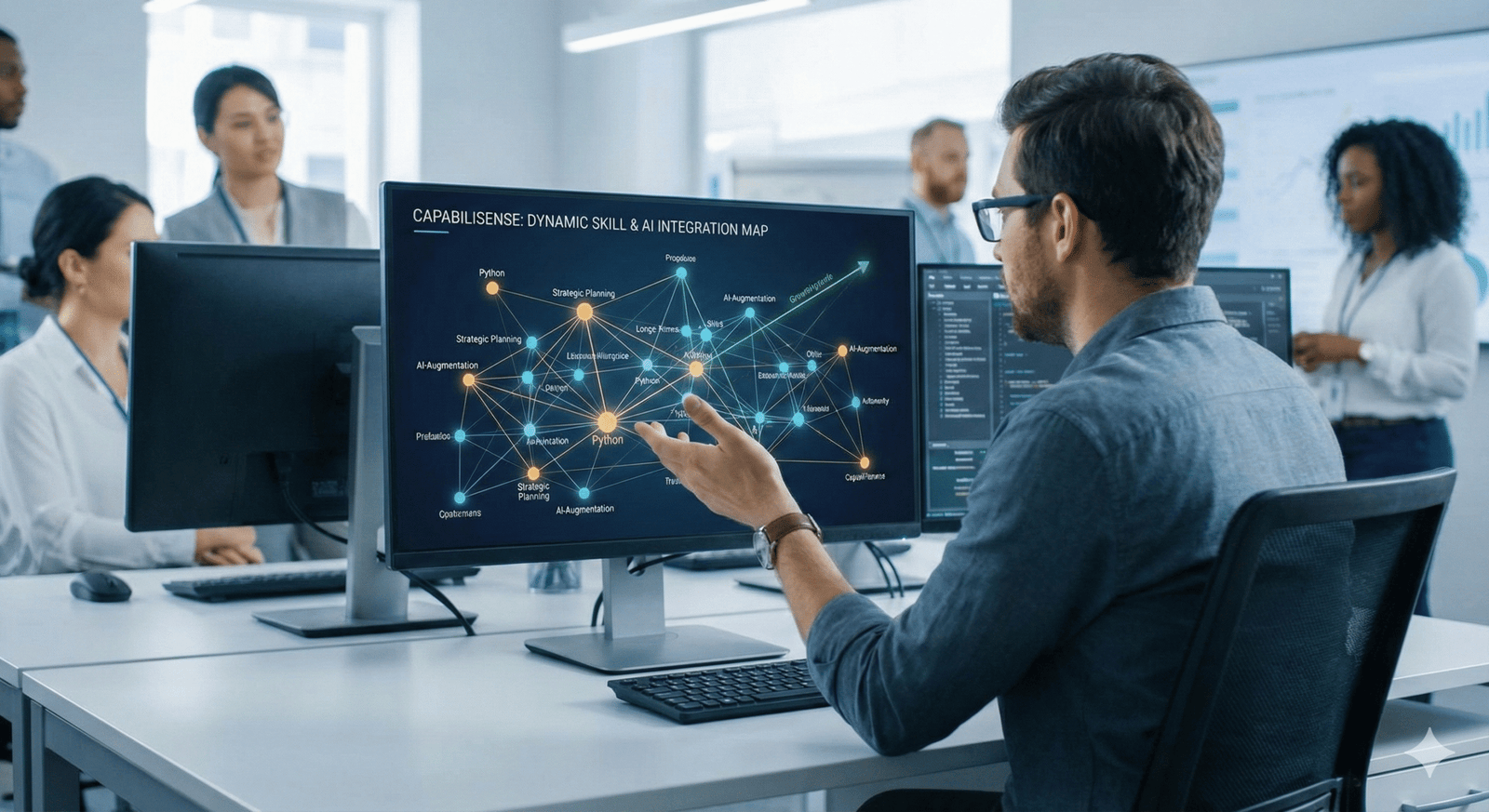
The flagship feature of Capabilisense is the Dynamic Skill Graph. Imagine a visualization of your team where skills pulse and grow in real-time based on actual project contributions. If a developer starts using Rust in a project, their Rust capability node expands automatically no manual update required.
- Real-time Updates: Skills update as work happens.
- Decay Algorithms: Skills that aren’t used slowly fade, reflecting reality.
- Cluster Analysis: Finding hidden talent clusters within the org.
Privacy First: The Anti-Surveillance Stance
One of the biggest hurdles in why I’m building Capabilisense was addressing the privacy concern. In an era of “bossware,” trust is low. We made a foundational decision: Capabilisense analyzes work artifacts, not worker behavior. We do not track keystrokes, screen time, or mouse movement.
We employ “Local Differential Privacy” techniques.
- Anonymization: Data is aggregated before insight generation.
- User Control: Employees own their skill graph, not the company.
- Transparency: Open-source code for data collection modules.
The Tech Stack: Building for Scale
To achieve the low latency required for real-time sensing, we opted for a high-performance stack. We use Rust for the data ingestion engine due to its memory safety and speed, ensuring that our “sensing” adds zero latency to the user’s workflow.
The frontend is built on Next.js for reactivity, while the backend leverages a vector database to handle the semantic understanding of skills and tasks. This allows us to match “fuzzy” concepts like realizing that “client negotiation” and “conflict resolution” are related skills.
Comparing Capabilisense to Traditional Tools
It is vital to understand where we fit in the market. We are not an HRIS, and we are not a spyware tool.
| Feature | Traditional HRIS (e.g., Workday) | Productivity Trackers (e.g., Hubstaff) | Capabilisense |
| Primary Metric | Employment History | Hours / Activity | Capability / Potential |
| Data Source | Manual Entry | Keystrokes / Screenshots | Work Artifacts / Context |
| Update Frequency | Annual/Quarterly | Real-time | Real-time |
| Privacy Focus | Low | Very Low (Intrusive) | High (Artifact-based) |
| AI Integration | None/Minimal | None | Native / Core Feature |
The Role of LLMs in Contextual Analysis
Large Language Models (LLMs) are the engine that makes Capabilisense possible today. Previous attempts at skill mapping failed because software couldn’t understand context. An LLM can read a code comment or a project brief and understand the nuance of the skills required.
We fine-tune open-source models (like Llama 3) to specialize in “corporate competence understanding,” allowing us to run efficient inference without sending sensitive data to public API endpoints.
Solving the “Skill Gap” Crisis
The World Economic Forum predicts that 50% of all employees will need reskilling by 2025. Why I’m building Capabilisense is to provide the map for this reskilling journey. You cannot fix a gap you cannot see.
Capabilisense provides:
- Instant Gap Detection: “We have a project requiring Python, but our Python capability is down 20%.”
- Learning Pathways: Suggesting micro-projects to build specific missing skills.
- Mentorship Matching: Pairing high-capability users with learners automatically.
Integration Ecosystem
A tool is useless if it exists in a silo. We are building Capabilisense to be the “connective tissue” between your existing stack. We are launching with native integrations for GitHub, Jira, Slack, and Notion.
By tapping into these APIs, Capabilisense sits quietly in the background, listening to the “digital exhaust” of a company and turning it into actionable intelligence.
- GitHub: For coding capability.
- Slack: For communication and leadership sensing.
- Jira: For execution and velocity tracking.
Case Study: The Beta Test
In early 2025, we ran a closed beta with a mid-sized digital agency. They were struggling with resource allocation senior devs were doing junior work, and juniors were overwhelmed.
The Result: After two weeks of “sensing,” Capabilisense identified that 30% of their “Design” team had developed undocumented frontend coding skills. The agency reallocated resources based on this data, reducing their contractor spend by $15k/month and increasing project delivery speed by 18%.
Overcoming Development Challenges
Building this has not been easy. The primary challenge was “Entity Resolution” figuring out that “JS,” “JavaScript,” and “ECMAScript” are the same skill node. We spent months training our entity resolution models to handle the messy, informal jargon used in real companies.
Another challenge was scalability. Graph databases can become slow with massive datasets. We implemented a “sharded graph” approach to ensure queries remain instantaneous even as organizations grow to thousands of users.
The “Proof of Capability” Protocol
We are working on a decentralized feature called “Proof of Capability.” This uses cryptographic signatures to verify that a user actually possesses the skills their graph claims. This is why I’m building Capabilisense with a Web3-ready architecture in mind to eventually allow users to take their verified skill graph with them when they change jobs.
- Portable Reputation: Your skills belong to you.
- Verified Credentials: cryptographic proof of project contributions.
Future Roadmap: Predictive Team Building
The ultimate goal is predictive analytics. We want Capabilisense to look at a project brief and tell you, “Based on current capability trends, this project has a 40% chance of delay due to a lack of backend infrastructure skills.”
We are currently training models on project success/failure rates to build this “Project Health Predictor,” which we aim to release in Q4 2026.
User Feedback and Iteration
We are building in public because feedback is oxygen. Early users have praised the “passive” nature of the tool they love getting insights without having to fill out forms. However, we also heard concerns about “metric gaming.”
To combat this, we are refining our algorithms to detect “spammy” work designed just to boost scores, ensuring the integrity of the capability data remains high.
Join the Revolution
Capabilisense is more than software; it is a movement toward a more transparent, meritocratic, and efficient way of working. By understanding the true capabilities of our teams, we unlock human potential that is currently trapped in bad processes and opaque management structures.
This journey is just beginning. We are looking for forward-thinking organizations to join our next beta cohort and help shape the future of work intelligence.
FAQs
What exactly is Capabilisense?
Capabilisense is a “capability sensing” platform that analyzes work artifacts from tools like GitHub, Jira, and Slack to create real-time, dynamic skill graphs for teams. It helps organizations understand their actual workforce potential without invasive surveillance or manual data entry.
How does Capabilisense protect employee privacy?
Privacy is central to why I’m building Capabilisense. We use Local Differential Privacy and analyze work outputs (code, documents) rather than user behavior (keystrokes, screen time). Data is anonymized where possible, and employees retain ownership and visibility of their own skill graphs.
Is this tool suitable for non-technical teams?
Yes. While our initial integrations focus on dev tools (GitHub), the semantic engine is designed to analyze text from Notion, Google Docs, and email. This allows us to map soft skills, project management capabilities, and creative skills just as effectively as coding languages.
How does Capabilisense differ from a standard HRIS?
A standard HRIS (Human Resource Information System) is a system of record containing static data like job titles and salary history. Capabilisense is a system of intelligence containing dynamic data about what people can actually do right now. It updates in real-time, whereas HRIS data is often stale.
Can Capabilisense detect AI usage?
Yes. One of our core features is the “Augmentation Score.” We analyze how effectively team members are prompting AI agents and integrating AI-generated code or text into their workflows, helping companies identify their most “AI-native” employees.
What integrations are currently available?
We currently support native integrations with GitHub, GitLab, Jira, Slack, and Notion. We have a robust API that allows for custom integrations with enterprise proprietary tools, and we are actively working on connectors for Figma and Salesforce.
How much does Capabilisense cost?
We operate on a tiered SaaS model. There is a free tier for small teams (up to 5 users) to encourage grassroots adoption. For larger organizations, we charge per active user/month, with enterprise pricing available for on-premise deployments and custom data retention policies.
Conclusion
In conclusion, why Im building Capabilisense comes down to a fundamental belief: we cannot navigate the future of work with maps from the past. As AI transforms every industry, the organizations that succeed will not be the ones with the most employees, but the ones with the deepest understanding of their capabilities. Capabilisense bridges the gap between the chaos of daily operations and the clarity of strategic insight.
By automating the discovery of skills, protecting user privacy, and embracing the hybrid human-AI workflow, we are building a tool that doesn’t just measure work it improves it. This is a commitment to a future where talent is visible, growth is measurable, and potential is realized. I invite you to follow our development, challenge our assumptions, and use Capabilisense to uncover the hidden superpowers within your own team.