
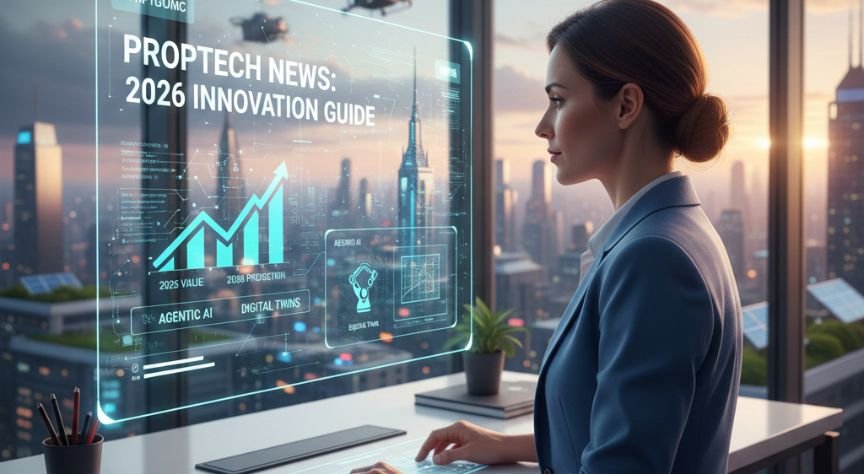
The global real estate landscape is undergoing a tectonic shift as digital transformation moves from a luxury to a fundamental requirement. Staying updated with the latest proptech news is no longer just for the tech-savvy investor; it is the primary survival strategy for developers, brokers, and property managers alike. As we navigate through 2026, the convergence of artificial intelligence, sustainable building technologies, and decentralized finance is redefining how we interact with the “built environment.”
This comprehensive guide serves as your strategic briefing on the most significant shifts in property technology. We will explore how “Agentic AI” is replacing basic chatbots, why ESG compliance is driving billion-dollar software investments, and how the rise of digital twins is saving millions in operational costs. Whether you are an institutional player or a residential agent, the insights below provide the roadmap needed to leverage technology for a competitive edge in an increasingly automated market.
The Rise of Agentic AI in Property Management
The most significant proptech news of early 2026 is the transition from generative AI to Agentic AI. Unlike previous models that merely answered questions, these autonomous agents can execute complex workflows independently.
- Autonomous Maintenance: AI agents now predict HVAC failures and automatically hire contractors within pre-approved budget limits.
- Tenant Relations: Virtual managers handle the entire leasing lifecycle, from initial inquiry to digital lease execution, without human intervention.
- Operational Efficiency: Firms using agentic systems report a 30% reduction in administrative overhead.
Decarbonization and the Surge of GreenTech
Sustainability is no longer a marketing buzzword; it is a regulatory mandate. Recent proptech news highlights a massive influx of capital into energy management software.
- Carbon Tracking: Real-time dashboards now provide building-level emissions data required for mandatory ESG reporting.
- Smart Retrofitting: AI-driven tools analyze older structures to suggest the most cost-effective insulation and solar upgrades.
- Net-Zero Growth: Investment in “Clean Proptech” has grown by 18% year-over-year as developers chase tax incentives.
Digital Twins: Beyond 3D Visualization
The application of digital twins virtual replicas of physical buildings has evolved from design concept to operational standard in 2026.
- Predictive Modeling: Managers use twins to simulate the impact of extreme weather events on building structures.
- Energy Optimization: By syncing with IoT sensors, digital twins adjust lighting and heating in real-time based on occupancy.
- Construction Safety: Contractors use these models to identify potential safety hazards before a single brick is laid.
Blockchain and the Tokenization of Real Estate
Blockchain technology is finally maturing beyond the hype, offering genuine solutions for liquidity in the property market.
- Fractional Ownership: Retail investors can now buy “shares” of commercial skyscrapers for as little as $500 via regulated token platforms.
- Smart Contracts: Leasing agreements on the blockchain ensure that rent distributions and security deposits are handled instantly and transparently.
- Reduced Intermediaries: Tokenized transactions are cutting closing times from weeks to mere hours by eliminating redundant title checks.
The Evolution of Immersive Virtual Tours
The latest proptech news in marketing focuses on high-fidelity, interactive property experiences that go far beyond a standard 360-degree photo.
- Adaptive Environments: Potential buyers can now change wall colors, furniture styles, and lighting within a virtual tour in real-time.
- Haptic Integration: High-end virtual tours now incorporate haptic feedback, allowing users to “feel” the textures of countertops or flooring.
- Global Reach: International sales have surged as VR technology removes the physical barriers of cross-border investing.
Fintech Integration: The “Embedded Everything” Era
Proptech and Fintech have merged into a unified ecosystem where financial services are baked directly into property platforms.
- Instant Mortgages: AI-driven underwriting allows for mortgage approval within the property search app.
- Rent Now, Pay Later (RNPL): Flexible payment structures are becoming a standard feature in residential tenant portals.
- Automated Escrow: Integrated payment gateways handle complex transaction waterfalls automatically, reducing the risk of human error.
Proptech Market Size and 2026 Growth Projections
The economic footprint of the industry is expanding rapidly. Data from the first quarter of 2026 shows a market that is both resilient and aggressive.
| Metric | 2025 Value (Actual) | 2026 Projection |
| Global Market Size | $40.19 Billion | $44.59 Billion |
| Cloud Deployment Share | 51.2% | 55.48% |
| AI-Integrated Solutions | 42% | 68% |
| CAGR (2026-2034) | 11.5% | 11.9% |
Smart Cities and Urban Tech Connectivity
Proptech news is increasingly intersecting with urban planning as buildings become “nodes” in a larger smart city network.
- Grid Interaction: Buildings now sell excess solar energy back to the city grid during peak demand hours.
- Traffic Integration: Commercial parking garages use AI to dynamically price spots based on real-time city traffic data.
- Waste Management: IoT-enabled bins communicate with city collection services to optimize routes and reduce fuel costs.
Cybersecurity: Protecting the Digital Home
As buildings become more connected, they also become more vulnerable. The focus on cybersecurity has become a top priority in 2026.
- Encrypted Access: Biometric and blockchain-based keys are replacing traditional fobs to prevent unauthorized digital entry.
- Data Privacy: New protocols ensure that tenant behavior data collected by smart sensors is anonymized and encrypted.
- Cyber Insurance: Property owners are increasingly required to hold specialized insurance policies against “building hacks.”
The Shift to “Proptech-as-a-Service”
Software-as-a-Service (SaaS) models are evolving into a more flexible “as-a-Service” approach for the entire property lifecycle.
- Modular Tech Stacks: Instead of buying one large platform, firms are using APIs to build custom stacks of niche proptech tools.
- Scalability: Smaller landlords now have access to enterprise-grade tools through tiered subscription models.
- Unified Data: The focus is on breaking down silos so that marketing, management, and maintenance data all live in one place.
Robotics in Construction and Maintenance
Physical automation is finally hitting the mainstream, addressing the chronic labor shortages in the real estate sector.
- 3D Printing: Entire residential communities are being 3D printed in half the time of traditional construction.
- Drone Inspections: High-definition drones perform roof and facade inspections, identifying cracks and leaks that are invisible to the naked eye.
- Cleaning Bots: Commercial buildings are deploying autonomous fleets for janitorial work and window cleaning.
Predictive Analytics for Smarter Investment
Investors are moving away from historical data and toward forward-looking predictive models.
- Gentrification Forecasting: AI analyzes social media trends and permit filings to identify “the next big neighborhood” before prices rise.
- Risk Mitigation: Climate change models help investors avoid properties at high risk of flooding or wildfire over the next 30 years.
- Tenant Churn Prediction: Property managers use behavioral data to identify tenants likely to leave, allowing for proactive retention offers.
Case Study: Dubai’s Digital Transformation
Dubai has become a global testbed for proptech innovation, hosting the Middle East’s largest tech summit in February 2026.
The Dubai Strategy 2033: By integrating blockchain for all land registry transactions and mandating digital twins for new developments, Dubai has increased market transparency by 40%. The result has been a 15% increase in foreign direct investment into their real estate sector.
Co-working and the New Office Reality
The “death of the office” was exaggerated; instead, we are seeing the rise of “Flex-Tech.”
- Hot-Desking AI: Apps that use real-time sensors to help employees find available desks and meeting rooms.
- Community Platforms: Software that connects tenants within a building to foster networking and shared services.
- Hybrid Management: Tools that help HR teams manage a workforce spread across home offices and satellite hubs.
The Human Element: Training the Next Generation
A recurring theme in recent proptech news is the “talent gap.” Having the tech is only half the battle; knowing how to use it is the other.
- Upskilling Programs: Leading firms are spending 5% of their revenue on AI literacy training for their staff.
- The “Human” Value: As tech handles the data, agents are pivoting to focus on high-touch advisory and emotional intelligence.
- Chief Technology Officers: Most mid-to-large real estate firms have now appointed a CTO to oversee their digital roadmap.
The Future of Home Automation (IoT)
The “Smart Home” has matured into the “Intuitive Home,” where the house learns your habits.
- Energy Intuition: Thermostats that adjust not just to your schedule, but to real-time energy prices on the grid.
- Health Sensors: Homes that monitor air quality and water purity, automatically ordering filter replacements when needed.
- Security Automation: AI cameras that can distinguish between a delivery person, a neighbor, and a potential intruder.
FAQs
What is the biggest trend in proptech for 2026?
The dominant trend is the shift toward Agentic AI. Unlike previous AI that required constant prompts, Agentic AI can work autonomously to solve property management issues, conduct market research, and execute transactions.
How is AI changing property valuations?
AI now uses massive datasets including neighborhood foot traffic, social media sentiment, and local economic shifts to provide real-time valuations that are far more accurate than traditional appraisals.
Is blockchain actually being used in real estate now?
Yes, in 2026, blockchain is primarily used for tokenization of commercial assets and securing land registry records in progressive markets like Dubai and Singapore.
What are “Digital Twins” and why do they matter?
A Digital Twin is a virtual 3D replica of a physical building. It allows owners to test maintenance scenarios and energy-saving measures in a digital environment before implementing them in the real world.
How does proptech help with sustainability?
Proptech provides the sensors and software needed to track carbon footprints, optimize energy usage, and manage waste, which is essential for meeting new ESG (Environmental, Social, and Governance) regulations.
Conclusion
The evolution of property technology is no longer a slow-moving trend; it is a rapid revolution. As highlighted throughout this deep dive into proptech news, the industry is moving toward a future that is more transparent, efficient, and sustainable. From the autonomous capabilities of Agentic AI to the democratic potential of real estate tokenization, the tools available today are fundamentally changing the value proposition of real estate.
Success in this new era requires more than just capital; it requires a commitment to digital literacy and an openness to constant innovation. By embracing these technologies, stakeholders can mitigate risks, maximize ROI, and provide a superior experience for tenants and buyers. The “built environment” of 2026 is smarter than ever, and those who ignore the signals do so at their own peril. As the lines between tech and real estate continue to blur, the most successful players will be those who view property not just as physical space, but as a digital asset to be optimized.