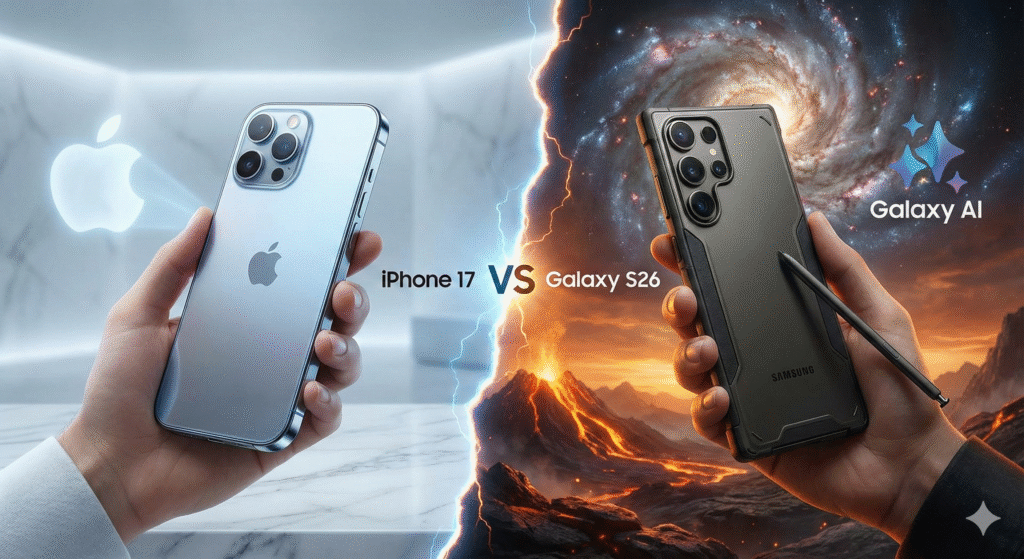
The battle for smartphone dominance has never been fiercer. As we approach the next generation of mobile technology, the rivalry between Apple and Samsung is reaching a boiling point. If you are torn between the ecosystem stability of the iPhone 17 and the raw power of the Galaxy S26, you are not alone. These two devices represent the pinnacle of engineering, each promising to redefine how we communicate, work, and play.
In this comprehensive guide, we move beyond the rumors to analyze the concrete differences that matter to you. From the “slimmest ever” designs to the AI-powered processor wars, we break down every specification. Whether you are a creative professional needing top-tier cameras or a power user demanding all-day battery life, this comparison will help you decide which flagship deserves a place in your pocket in 2026
Design Philosophy: The War on Thickness
For years, phones kept getting thicker to accommodate larger batteries, but 2026 marks a return to sleekness. The Galaxy S26 series is rumored to be thinner than ever, with the base model measuring just 6.9mm. This is a direct challenge to Apple’s design team.
- Samsung’s Approach: A new “dark frame” design with matte finishes and sharper corners on the Ultra model gives it a distinct, professional look.
- Apple’s Move: The introduction of the “iPhone 17 Air” signals a focus on ultra-thin portability, replacing the bulkier Plus model with a device that prioritizes comfort and style over raw battery size.
Display Technology: 120Hz for Everyone
Finally, the gap in display fluidity is closing. The standard iPhone 17 is expected to adopt ProMotion (120Hz) technology, a feature Samsung has offered on base models for years. This levels the playing field significantly for budget-conscious buyers who want smooth scrolling without going “Pro.”
- Refresh Rate: Both base models now support adaptive 1-120Hz rates, making animations look fluid and responsive.
- Brightness: Apple targets 3,000 nits peak brightness for outdoor visibility, while Samsung focuses on efficiency and advanced anti-reflective coatings to reduce glare.
Processor Power: A19 Pro vs. Snapdragon 8 Gen 5
The silicon race is tighter than it has been in a decade. Apple’s A19 chip continues to lead in single-core efficiency, but Qualcomm’s Snapdragon 8 Gen 5 (likely the “For Galaxy” edition) is showing terrifyingly fast multi-core scores in leaked benchmarks.
- A19 Pro: Built on an enhanced 3nm process, this chip focuses on thermal management and sustained performance to prevent overheating during heavy tasks.
- Snapdragon 8 Gen 5: Expected to utilize custom Oryon cores that rival desktop-class performance, making it a beast for multitasking and gaming.
RAM and Multitasking Capabilities
With on-device AI becoming standard, RAM is no longer just about keeping apps open; it is about processing data locally. Samsung is likely pushing 12GB as the standard across the board, with the Ultra hitting 16GB. Apple is rumored to bump the non-Pro models to 8GB or 12GB to support Apple Intelligence features.
- Galaxy S26: 12GB / 16GB LPDDR5X configurations ensure apps stay open in the background for longer.
- iPhone 17: 12GB expected for Pro models to handle advanced AI tasks without reloading apps.
Camera Hardware: Megapixel Wars Continue
Samsung continues to bet on high-resolution pixel binning with a refined 200MP main sensor for the Ultra. Apple, meanwhile, focuses on sensor size and “Fusion” camera technology, likely upgrading the telephoto lens to 48MP across the Pro line for sharper zoom crops.
- Samsung: 200MP Main + 50MP Telephoto + 12MP Ultrawide offers incredible detail in well-lit shots.
- Apple: 48MP Main + 48MP Telephoto + 48MP Ultrawide (Triple 48MP system) ensures consistency across all three lenses.
Zoom Capabilities and Optics
The Galaxy S26 Ultra will arguably remain the king of zoom, retaining its 10x optical equivalent capabilities through high-res cropping and periscope lenses. Apple’s 5x tetraprism lens is excellent, but for extreme long-range photography, Samsung’s hardware physics still hold the advantage.
- Space Zoom: Samsung’s AI-assisted 100x zoom gets stabilization updates, making it easier to frame distant subjects.
- Tetraprism: Apple’s 5x optical zoom is expected to trickle down or improve in light sensitivity, offering better night-time zoom shots.
Video Performance and Features
Apple traditionally dominates video, and the iPhone 17 aims to secure this lead with improved ProRes capabilities and better low-light stabilization. However, Samsung is countering with 8K video recording that is finally usable, thanks to the Snapdragon 8 Gen 5’s superior ISP (Image Signal Processor).
- iPhone: Unmatched ProRes Log recording allows creators to color grade footage like a movie.
- Galaxy: 8K at 30fps with improved dynamic range provides the highest resolution capture available on a phone.
Battery Life Expectations
With the new A19 and Snapdragon chips focusing on efficiency, both phones will last longer. The iPhone 17 Pro Max is rumored to feature a stacked battery technology for higher density, potentially offering the longest battery life on any iPhone ever.
- Stacked Battery: Apple’s new tech could offer 10% more capacity in the same physical space.
- Optimization: Samsung relies on AI to kill background processes more aggressively, squeezing every drop of power from the cell.
Charging Speeds: Wired and Wireless
Samsung is rumored to finally upgrade its charging infrastructure, potentially hitting 60W wired charging on the Ultra and introducing 25W Qi2 wireless charging. Apple is expected to stick to conservative speeds but may improve MagSafe efficiency.
- Wired: Galaxy S26 Ultra (60W rumored) charges significantly faster than the iPhone 17 Pro Max (30-35W).
- Wireless: Both will support the universal Qi2 standard for magnetic charging, making accessories interchangeable.
Operating Systems: iOS 19 vs. One UI 8
The software experience is subjective but crucial. iOS 19 is expected to bring deeper customization to the lock screen and Control Center. One UI 8, built on Android 16, will likely focus on cross-device fluidity, making the phone work seamlessly with tablets and Windows PCs.
- iOS 19: Focuses on stability, privacy, and ecosystem lock-in, ensuring all your Apple devices talk to each other perfectly.
- One UI 8: Offers unmatched customization and multitasking (split-screen) features that power users love.
Artificial Intelligence Integration
This is the headline feature for 2026. “Apple Intelligence” vs “Galaxy AI.” Samsung has a head start with features like Live Translate and Circle to Search. Apple is playing catch-up but aims to integrate AI more deeply into the core system, making Siri actually useful.
- Galaxy AI: Generative photo editing and real-time call translation are already mature and useful features.
- Apple Intelligence: Context-aware notifications and personalized writing tools help you manage your digital life with less effort.
Connectivity Standards
Future-proofing is key. Both devices will feature Wi-Fi 7 and the latest Bluetooth standards. However, Apple is rumored to be debuting its own in-house 5G modem, which could offer better power efficiency during cellular data use compared to Qualcomm’s off-the-shelf modems.
- Wi-Fi 7: Blazing fast speeds for compatible routers ensure you get the most out of your gigabit internet.
- Modems: Apple’s custom silicon vs Qualcomm X85 5G modem will be a major test of connectivity stability.
Biometrics and Security
Samsung continues to use the ultrasonic under-display fingerprint sensor, which works even with wet fingers. Apple sticks resolutely to Face ID. Rumors suggest the iPhone 17 Pro might hide the Face ID sensors under the display, but this is a long-shot feature for this generation.
- S26: Ultrasonic Fingerprint + Face Unlock (2D) gives you options for how to unlock your phone.
- iPhone 17: Face ID (3D secure facial recognition) remains the gold standard for secure, hands-free unlocking.
Price and Value Proposition
Flagship prices are creeping up. The iPhone 17 is expected to start at $799, but the “Slim/Air” model might cost more than the Pro. Samsung will likely maintain aggressive trade-in deals, making the S26 series effectively cheaper for loyal customers upgrading from older models.
- iPhone: High upfront cost is offset by high resale value years down the line.
- Samsung: Frequent sales, bundles, and high trade-in values make it easier to upgrade annually.
Release Dates and Availability
Timing is everything. The iPhone 17 lineup will likely launch in September 2025, giving it a head start. The Galaxy S26 series will follow in January or February 2026, arriving with newer silicon that often benchmarks slightly higher due to the later release.
- Apple: Available Q4 2025, perfectly timed for the holiday season.
- Samsung: Available Q1 2026, setting the standard for the new year.
Resale Value and Longevity
If you plan to sell your phone in two years, the iPhone remains the safer investment. iPhones typically retain 40-50% of their value after two years. Samsung devices depreciate faster, though their promise of 7 years of OS updates helps maintain value better than before.
- Depreciation: Apple wins on residual value, putting more money back in your pocket when you upgrade.
- Updates: Both now offer industry-leading software support (5-7 years), meaning your phone stays secure for longer.
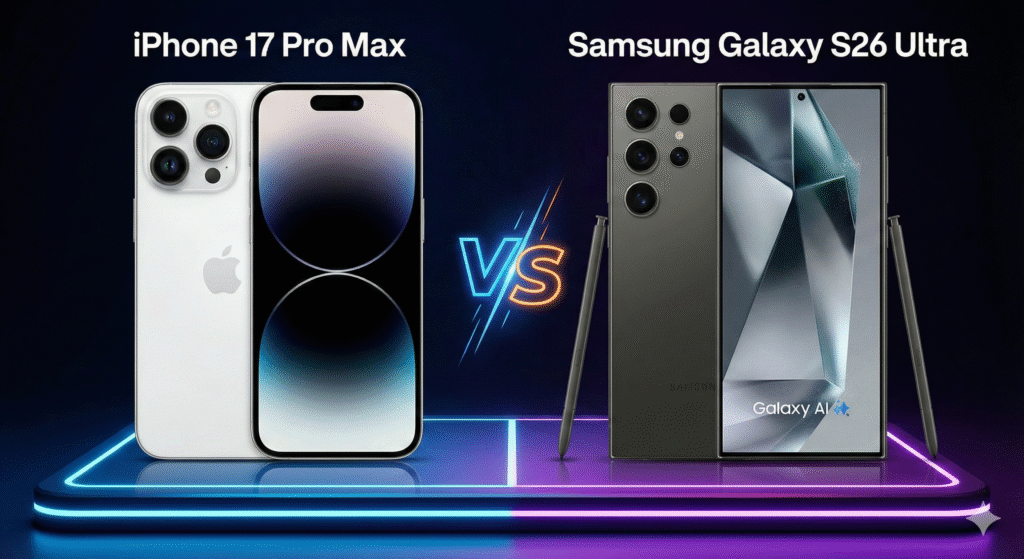
The “Air” vs. “Ultra” Factor
Apple is diversifying with a new “Air” model focused purely on aesthetics—thin, light, and chic. Samsung concentrates on the “Ultra”—a productivity beast with the S-Pen. These are two different philosophies: one values style and comfort, the other values raw utility and power.
- iPhone 17 Air: For the fashion-conscious minimalist who hates bulky pockets.
- S26 Ultra: For the power user who needs a stylus to sign documents or sketch on the go.
Verdict: Who is Each Phone For?
The choice comes down to your priorities. If you are a creative professional or deeply embedded in the Apple ecosystem, the iPhone 17 is the refined, reliable choice. If you crave the latest hardware, customizable software, and the best zoom camera on the market, the Galaxy S26 is the superior tech toy.
- Choose iPhone 17: For video, simplicity, and resale value.
- Choose Galaxy S26: For display customization, zoom photography, and multitasking.
Comparison: Flagship Specs Head-to-Head
| Feature | iPhone 17 Pro Max (Expected) | Samsung Galaxy S26 Ultra (Rumored) |
| Processor | Apple A19 Pro (3nm) | Snapdragon 8 Gen 5 (For Galaxy) |
| Main Camera | 48MP Fusion | 200MP ISOCELL HP2 (Refined) |
| Telephoto | 48MP (5x Optical) | 50MP (5x Optical) + 10MP (3x) |
| Battery | ~4,700 mAh (Stacked) | ~5,000 mAh |
| Charging | 35W Wired / 25W MagSafe | 60W Wired / 25W Qi2 Wireless |
| Biometrics | Face ID | Ultrasonic Fingerprint |
| Special Feature | Action Button / Camera Control | Integrated S-Pen Stylus |
Feature Breakdown: AI Capabilities
| Feature | Apple Intelligence | Galaxy AI |
| Voice Assistant | Context-aware Siri | Bixby / Gemini Integration |
| Image Editing | Clean Up (Object Removal) | Generative Edit (Move/Resize Objects) |
| Translation | Translate App | Real-time Live Call Translate |
| Writing Tools | Proofread & Rewrite | Note Assist & Summary |
Conclusion
The choice between the iPhone 17 and the Galaxy S26 is no longer just about hardware; it is about philosophy. Apple is refining perfection, focusing on a unified ecosystem, premium video capabilities, and the seamless integration of Apple Intelligence. It is the safe, polished choice that guarantees longevity and value.
On the other side, Samsung is pushing boundaries. The Galaxy S26 series, particularly the Ultra, offers a toolkit for the power user—better zoom, faster charging, and a multitasking interface that rivals laptops. If you want a phone that can do things no other device can, the Galaxy is your answer. Regardless of your choice, 2026 is shaping up to be a golden year for mobile technology consumers.