
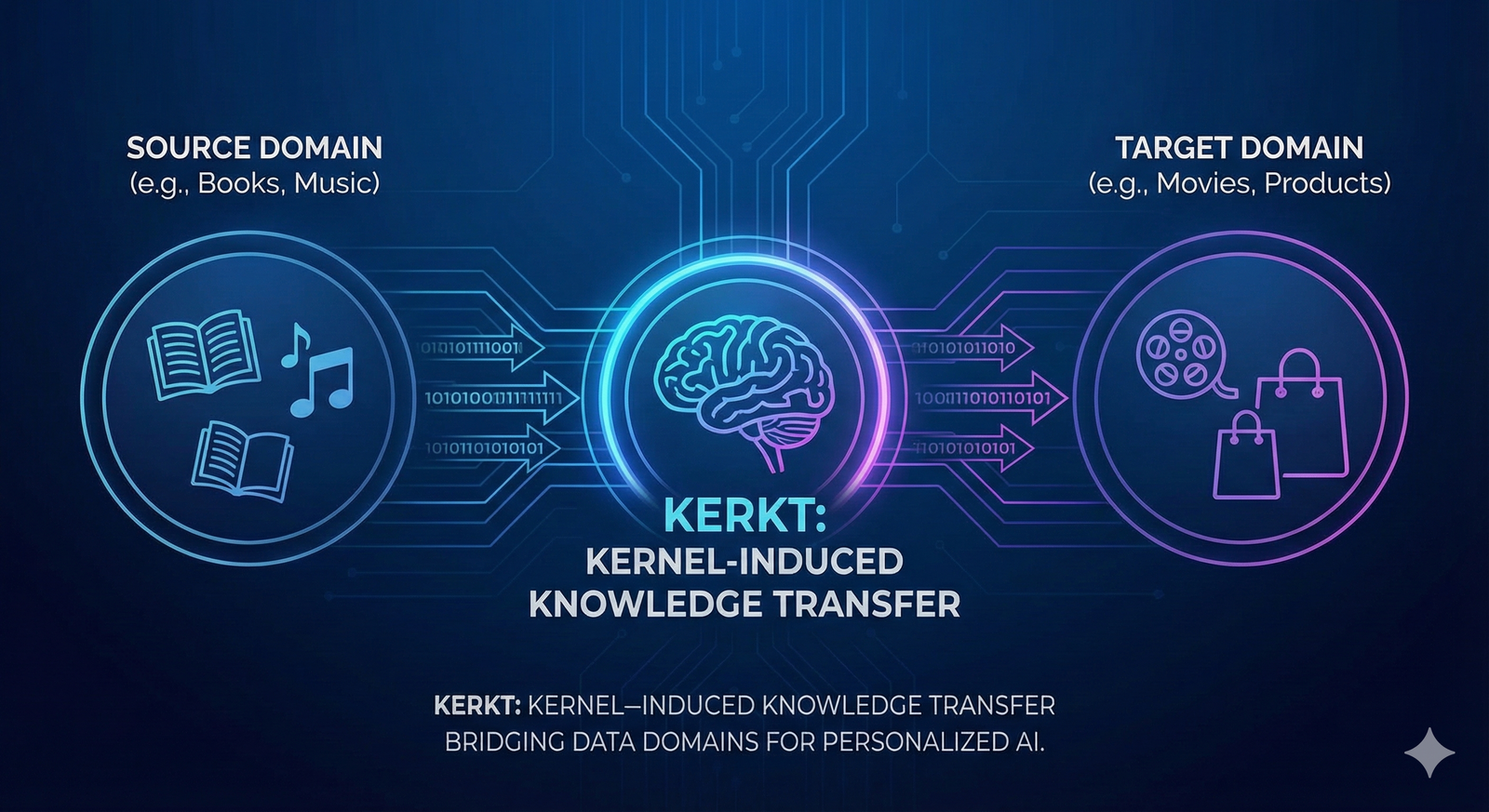
Imagine logging into a new streaming app. You haven’t watched a single movie yet, but the app already knows exactly what you like. How? It might be using your music playlist history to predict your movie taste. This magic is powered by a breakthrough in artificial intelligence called KerKT (Kernel-Induced Knowledge Transfer).
In the world of tech, data is the new oil. But what happens when an AI doesn’t have enough data to learn from? This is where KerKT changes the game. It is a sophisticated machine learning framework designed to solve one of the biggest headaches in the industry: the “Cold Start” problem. By transferring knowledge from one domain (like books you read) to another (like movies you watch), KerKT allows apps to make smarter, faster, and more accurate recommendations than ever before. In this guide, we will break down this complex tech into simple, actionable insights.
What is KerKT?
KerKT stands for Kernel-Induced Knowledge Transfer. It is a specialized algorithm used in Cross-Domain Recommender Systems (CDRS). Simply put, it helps computer systems “borrow” intelligence from one area to improve performance in another.
- Core Function: Transfers user preferences across different platforms.
- Key Tech: Uses “Kernel methods” to map complex data relationships.
- Primary Use: Improving personalization in apps and websites.
The Problem: Data Sparsity in AI
Most recommendation engines, like Netflix or Amazon, rely on your past history. But if you are a new user, the system has “sparse data” about you. It’s like trying to guess a stranger’s favorite food without talking to them.
- The Issue: AI cannot recommend products without prior interaction data.
- The Consequence: Poor user experience and irrelevant suggestions.
- The Fix: KerKT fills these gaps using data from other sources.
How KerKT Solves the Cold Start Problem
The “Cold Start” problem occurs when a new product or user enters a system. Traditional algorithms fail here because they need historical data to work. KerKT bypasses this by analyzing “overlapping entities.”
- Scenario: A user signs up for a new e-book app.
- Solution: KerKT looks at their existing social media interests.
- Result: The user gets perfect book suggestions instantly.
Understanding Cross-Domain Recommendation
Cross-Domain Recommendation (CDR) is the broader field where KerKT operates. While standard systems work in a single domain (e.g., recommending songs based on songs), CDR builds bridges between distinct worlds.
- Source Domain: The platform where data already exists (e.g., YouTube).
- Target Domain: The new platform needing help (e.g., a new podcast app).
- KerKT’s Role: The bridge that carries the data safely across.
The Role of Kernel-Induced Knowledge
The “Kernel” in KerKT refers to a mathematical function that helps the AI understand similarities between different things. It allows the system to see patterns that aren’t obvious on the surface.
- Pattern Recognition: Finds hidden links between unlike items.
- Flexibility: Can handle complex, non-linear data structures.
- Efficiency: Processes data faster than older linear models.
How Knowledge Transfer Actually Works
Knowledge transfer isn’t just copying and pasting data. It involves “mapping” features. KerKT takes the “DNA” of a user’s behavior in one app and translates it so another app can understand it.
- Step 1: Extract user features from the source.
- Step 2: Apply the kernel function to normalize the data.
- Step 3: Inject this “knowledge” into the target system.
Overlapping Entities Explained
For KerKT to function, there must be some “overlapping entities”—usually users who exist in both domains. If “User A” uses both App X and App Y, they become the key to unlocking insights for everyone else.
- Definition: Items or users present in both source and target datasets.
- Importance: They act as anchors for the algorithm.
- Optimization: KerKT maximizes the value derived from these few overlaps.
KerKT vs. Traditional Collaborative Filtering
Collaborative Filtering (CF) is the old school method. It groups people who liked similar things. KerKT is the modern upgrade that works even when the groups aren’t clearly defined yet.
| Feature | Collaborative Filtering (CF) | KerKT (Cross-Domain) |
|---|---|---|
| Data Source | Single Domain (Same App) | Multi-Domain (Different Apps) |
| Cold Start | Fails or performs poorly | Excellent performance |
| Accuracy | High (with lots of data) | High (even with less data) |
| Complexity | Low to Medium | High (Advanced AI) |
Key Components of the KerKT Architecture
The architecture of KerKT is built on three pillars: Matrix Factorization, Domain Adaptation, and Kernel Completion. These fancy terms just mean it breaks data down, adjusts it, and fills in the blanks.
- Matrix Factorization: Breaking huge data tables into manageable numbers.
- Domain Adaptation: Adjusting data to fit the new environment.
- Kernel Completion: Predicting missing links using math.
Real-World Applications of KerKT
This technology isn’t just theoretical; it’s powering the apps you use daily. From social networks suggesting friends to e-commerce sites showing you gadgets, KerKT is working silently in the background.
- Social Media: Friend suggestions based on phone contacts.
- Retail: Product ads based on search history.
- Travel: Hotel picks based on flight destinations.
Implementing KerKT in E-Commerce
Online stores lose millions when they show irrelevant products to new visitors. By implementing KerKT, a store can use a customer’s browser cookies or ad interactions to instantly personalize the storefront.
- Benefit: Increases conversion rates for new traffic.
- Strategy: Utilize third-party data to inform onsite recommendations.
- Outcome: A personalized shopping experience from click one.
Benefits for Streaming Services
Netflix and Spotify fight for your attention. The winner is usually the one who knows what you want to consume next. KerKT allows these giants to predict your mood based on diverse data points, like time of day or device used.
- Retention: Keeps users engaged longer.
- Discovery: Helps users find niche content they love.
- Growth: Reduces the “churn” of bored users cancelling subscriptions.
The Mathematics Behind the Magic
At its heart, KerKT relies on “Latent Feature Space.” Imagine a graph where “Action Movies” and “Video Games” are plotted close together. The math calculates the distance between these points to predict interest.
- Vectors: Users and items are stored as numerical coordinates.
- Kernels: Functions that measure similarity between coordinates.
- Optimization: Algorithms that minimize prediction errors.
Challenges in Adopting KerKT
While powerful, KerKT is not easy to build. It requires massive computing power and strict data privacy compliance. Transferring data between domains often raises legal and ethical questions.
- Privacy: GDPR and CCPA laws restrict data sharing.
- Computation: Requires high-end GPUs for training models.
- Complexity: Needs skilled data scientists to tune the kernels.
Future Trends in Recommendation Tech
The future of KerKT lies in “Federated Learning,” where the model learns on your device without sending private data to a central server. This combines the power of KerKT with absolute privacy.
- Privacy-First AI: Personalization without data tracking.
- Real-Time Processing: Recommendations that update in milliseconds.
- IoT Integration: Smart fridges suggesting recipes based on gym data.
Why Developers Should Learn KerKT
For software engineers and data scientists, mastering KerKT is a career booster. Companies are desperate for experts who can build systems that work across different platforms and datasets.
- High Demand: Tech giants are hiring CDRS experts.
- Skill Gap: Few developers understand Kernel methods deeply.
- Innovation: It’s the frontier of personalized AI.
Tools and Libraries for KerKT
You don’t have to start from scratch. Several Python libraries and AI frameworks support the building blocks needed to create a KerKT system.
- TensorFlow: Google’s open-source machine learning library.
- PyTorch: Great for building dynamic neural networks.
- Scikit-learn: Useful for basic kernel functions and data prep.
Summary of KerKT’s Impact
KerKT is more than just an acronym; it is the bridge to a smarter, more connected digital experience. It solves the critical problem of isolation between different apps, allowing for a unified understanding of user needs.
- Efficiency: Saves computational resources by reusing knowledge.
- User Experience: Creates a seamless “magic” feel for users.
- Business Value: Drives sales and engagement through better prediction.
Comparison: Recommendation Techniques
To understand why KerKT is superior for modern apps, let’s compare it with standard methods used in the industry today.
| Feature | Content-Based Filtering | Collaborative Filtering | KerKT (Hybrid/Cross-Domain) |
|---|---|---|---|
| Logic | “You liked X, so you will like Y” | “People like you liked Z” | “You liked A in App 1, so you will like B in App 2” |
| New User Handling | Average | Poor | Excellent |
| Data Requirements | High per user | High per group | Low per domain (uses transfer) |
| Computational Cost | Low | Medium | High |
Frequently Asked Questions
Is KerKT suitable for small businesses?
Yes, but it depends on your data ecosystem. If a small business has multiple touchpoints (like a website, an app, and an email list), KerKT can help unify that data to provide better customer service and product suggestions.
Do I need to know Python to use KerKT?
Generally, yes. Implementing a KerKT system usually requires knowledge of programming languages like Python or R, along with a strong understanding of machine learning libraries like TensorFlow or PyTorch.
Is KerKT safe for user privacy?
It can be. When implemented correctly with techniques like “Federated Learning” or data anonymization, KerKT can transfer “patterns” of behavior without ever exposing the actual sensitive data of a specific user.
How does KerKT handle completely new items?
KerKT excels here. By analyzing the “attributes” of a new item and comparing them to similar items in a different domain (the Source Domain), it can predict how users will react to the new item before anyone has even interacted with it.
Can KerKT work between two rival companies?
Technically, yes, but practically, no. Companies rarely share data. KerKT is mostly used within a single large ecosystem (like Google using Search data to improve YouTube recommendations) or via public open datasets.
What is the main downside of KerKT?
The complexity. Setting up the “Kernel” functions to correctly map data between two very different domains (like mapping “music” preferences to “clothing” choices) is mathematically difficult and prone to errors if not tuned effectively.
Will KerKT replace human marketers?
No. KerKT is a tool that helps marketers work smarter. It handles the heavy lifting of data analysis and prediction, allowing humans to focus on creative strategy, content creation, and brand building.
Conclusion
In the rapidly evolving landscape of technology, KerKT represents a significant leap forward. It moves us away from isolated data silos and toward a more integrated, intelligent digital world. By solving the persistent “Cold Start” problem and enabling accurate Cross-Domain Recommendations, KerKT ensures that users get value from the very first click.
For developers, businesses, and tech enthusiasts, understanding KerKT is no longer optional—it is essential. As we move into an era of hyper-personalization, the ability to transfer knowledge across domains will be the defining factor between apps that annoy us and apps that truly understand us. Whether you are building the next big platform or just trying to optimize your current stack, exploring the potential of KerKT is your next logical step.