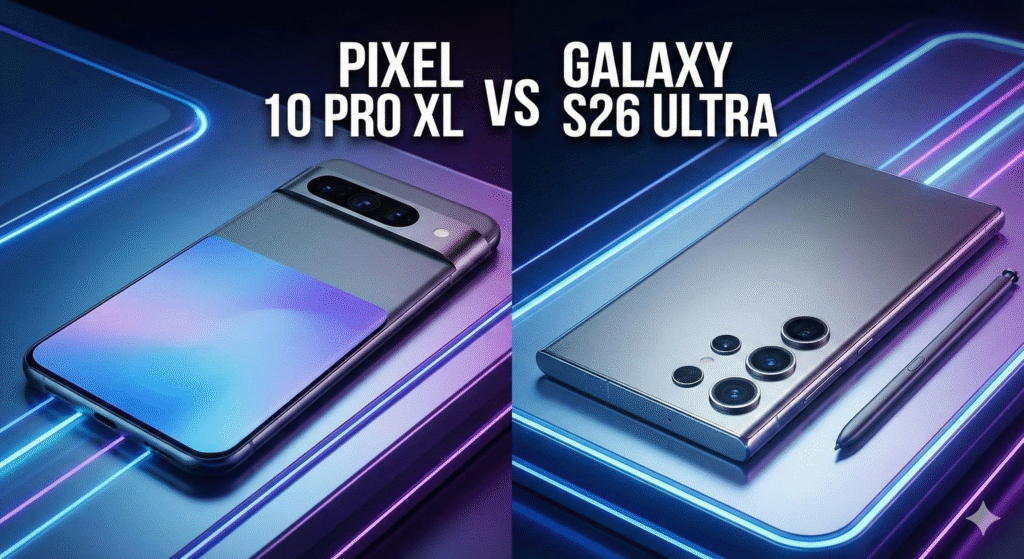
The battle for Android supremacy has never been this intense. On one side, we have Google’s latest masterpiece, the Pixel 10 Pro XL, which has finally ditched older manufacturing processes for a cutting-edge TSMC-made chip. It is smarter, faster, and cooler than any Pixel before it. On the other side looms the shadow of the upcoming giant, the Samsung Galaxy S26 Ultra, expected to redefine raw performance in early 2026.
If you are currently holding your wallet, torn between buying Google’s AI-powered marvel now or waiting for Samsung’s productivity beast, this guide is for you. We are breaking down every detail, from the camera sensors to the battery cells, to help you decide which flagship deserves to be your daily driver.
Design Philosophy and Build Quality
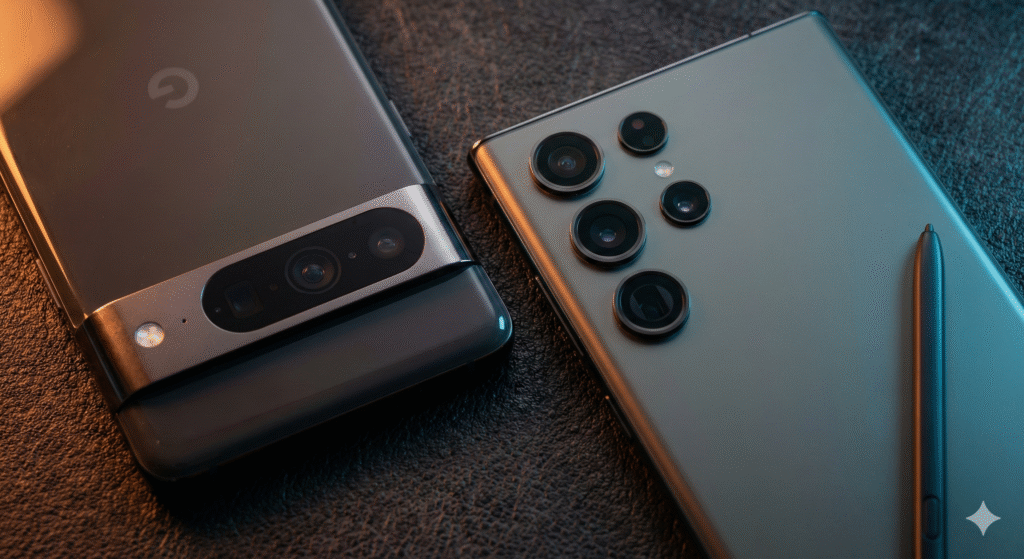
The first interaction you have with a phone is physical, and these two take very different approaches to luxury. The Pixel 10 Pro XL continues to refine its friendly, organic aesthetic. It features rounded corners that dig less into your palm and the signature “visor” camera bar that allows the phone to sit flat on a desk.
- Pixel 10 Pro XL: Polished aluminum rails, matte glass back, and an ergonomic curve.
- Galaxy S26 Ultra: Expected to maintain the industrial “Note” DNA with a titanium frame and sharper corners, though rumors suggest a slight softening for better comfort.
Display Technology and Brightness
Google has leveled the playing field with its Super Actua display technology. The screen on the Pixel 10 Pro XL is stunningly bright, cutting through direct sunlight with ease. However, Samsung manufactures the best panels in the world, and the S26 Ultra is expected to push boundaries further.
- Pixel Peak Brightness: Hits an incredible 3300 nits.
- Galaxy Expectations: Likely to feature new anti-reflective coating technology and brightness exceeding 3500 nits.
Processor Performance Showdown
This is the most significant technical divergence. The Pixel 10 Pro XL runs on the Tensor G5, the first chip fully designed by Google and built on TSMC’s 3nm process. It prioritizes efficiency and AI tasks. The Galaxy S26 Ultra, conversely, will likely sport the Snapdragon 8 Gen 5, a chip designed for sheer, unadulterated speed.
- Tensor G5: Optimized for voice typing, call screening, and background AI tasks.
- Snapdragon 8 Gen 5: Built for high-fidelity gaming and heavy multitasking.
RAM and Multitasking Capabilities
Memory management plays a huge role in how a phone feels after months of use. Google has equipped the Pixel 10 Pro XL with generous RAM to handle on-device Gemini AI models. Samsung is known for pairing high RAM with aggressive background management to save battery.
- Pixel: 16GB of LPDDR5X RAM standard on Pro models.
- Galaxy: Expected to offer 12GB and 16GB variants, optimized for DeX and split-screen usage.
Main Camera Performance
Photography is the battleground where these two titans clash hardest. The Pixel 10 Pro XL vs Galaxy S26 Ultra camera debate comes down to philosophy. Google uses a 50MP sensor with heavy computational magic to freeze motion and render accurate skin tones. Samsung typically employs a massive 200MP sensor to capture immense detail.
- Pixel Strength: “Point and shoot” reliability, especially with moving subjects like kids or pets.
- Galaxy Strength: High-resolution modes allowing for deep cropping without quality loss.
Zoom and Telephoto Capabilities
If you love taking photos of concerts, wildlife, or distant architecture, this section is vital. The Pixel 10 Pro XL utilizes a 5x optical zoom lens that is incredibly sharp. However, Samsung is the undisputed king of long-range photography.
- Pixel: 5x Optical Zoom with Super Res Zoom up to 30x.
- Galaxy: Rumored to feature an improved variable telephoto system, offering superior clarity at 10x and digital zoom up to 100x.
Ultrawide and Macro Photography
Often overlooked, the ultrawide lens is essential for landscapes and tight interior shots. Both phones use these lenses for “Macro” modes (extreme close-ups). The Pixel’s ultrawide has a wider field of view this year, capturing more of the scene.
- Pixel Macro: Automatically engages to see dust-level details.
- Galaxy Ultrawide: Usually features excellent edge distortion correction.
Video Recording and Stabilization
Historically, the iPhone held the video crown, but Android is catching up. The Pixel 10 Pro XL introduces “Video Boost,” which processes your videos in the cloud to improve lighting and color. The Galaxy S26 Ultra relies on raw sensor power to shoot up to 8K resolution.
- Pixel Feature: Audio Magic Eraser removes background wind noise instantly.
- Galaxy Feature: Pro-grade video modes with manual controls for ISO and shutter speed.
Selfie and Front Camera Quality
Selfies are more than just vanity; they are for video calls and quick social updates. Google has upgraded the front camera on the Pixel 10 Pro XL to match the rear cameras’ quality, ensuring 4K video recording at 60fps.
- Skin Tones: Pixel’s Real Tone technology ensures accurate representation of all skin shades.
- Autofocus: Both devices feature autofocus on the front lens for sharp group shots.
Operating System and Software Updates
Longevity is key for a modern flagship. Both Google and Samsung have committed to an industry-leading seven years of OS and security updates. This means your phone will stay fresh until the early 2030s.
- Pixel Experience: Clean, bloat-free Android with “Pixel Drop” feature updates.
- Samsung Experience: One UI is feature-rich, offering deep customization and multitasking tools like Good Lock.
Artificial Intelligence Integration
The Pixel 10 Pro XL is marketed as an AI-first device. Gemini Nano is baked directly into the silicon, allowing for offline summarization and image generation. Samsung’s “Galaxy AI” is a hybrid, using a mix of on-device and cloud processing.
- Pixel: Call Screen handles spam calls for you; screenshots are searchable by content.
- Galaxy: Focuses on productivity AI, such as live translation during phone calls and note summarization.
Battery Life and Efficiency
Thanks to the switch to TSMC manufacturing for the chip, the Pixel 10 Pro XL has solved the heating and battery drain issues of the past. It is now a true all-day phone. The Galaxy S26 Ultra, with its physically larger footprint, is expected to house a massive battery.
- Pixel: Comfortable 24+ hour usage.
- Galaxy: Historically offers slightly better standby time due to display efficiency.
Charging Speeds
Waiting for a phone to charge is a pain point. Samsung is rumored to finally upgrade the charging speed on the S26 Ultra to compete with Chinese rivals, potentially hitting 60W or higher. Google has improved, but stays conservative.
- Pixel 10 Pro XL: 45W wired charging (approx. 70% in 30 mins).
- Galaxy S26 Ultra: Expected 65W wired charging for faster top-ups.
The S Pen Factor
This is the unique selling point that the Pixel simply cannot match. The Galaxy S26 Ultra houses the S Pen stylus inside its chassis. For artists, architects, or compulsive note-takers, this accessory alone decides the winner.
- Utility: Remote shutter for camera, air gestures, and precise document signing.
- Pixel Alternative: None native; requires capacitive third-party styluses.
Gaming and Thermal Management
Gamers demand sustained performance. While the Pixel 10 Pro XL can handle any game on the Play Store, the Galaxy S26 Ultra is built like a portable console. It typically features a larger vapor cooling chamber to dissipate heat during long sessions of Genshin Impact or Warzone.
- Pixel: Good for casual to moderate gaming.
- Galaxy: The choice for competitive mobile gamers.
Connectivity and Audio
Both flagships support the latest standards, including Wi-Fi 7 and Bluetooth 5.4. Audio quality from the stereo speakers is excellent on both, though Samsung tends to tune for a fuller, bass-heavy sound profile compared to the Pixel’s crisp, vocal-forward tuning.
- Haptics: The Pixel has some of the best haptic feedback (vibrations) in the Android world, making typing feel physical.
Ecosystem Integration
Your phone is the center of your digital life. The Pixel 10 Pro XL pairs flawlessly with the Pixel Watch and Pixel Buds Pro, creating a cohesive “Google” bubble. Samsung’s ecosystem is vaster, connecting with Galaxy Tabs, Galaxy Books, and even Samsung smart appliances.
- Continuity: Samsung devices allow you to copy text on your phone and paste it on your tablet instantly.
Price and Resale Value
The final hurdle is the cost. The Pixel 10 Pro XL launched at a premium price but frequently sees aggressive discounts and bundle deals. Samsung phones launch at a high price point and hold their trade-in value exceptionally well within the Samsung ecosystem.
- Buying Tip: Google often offers higher trade-in values for iPhones; Samsung offers great deals for previous Galaxy devices.
Comparison: The Specs at a Glance
For those who love the raw data, here is how the hardware stacks up.
| Feature | Google Pixel 10 Pro XL | Samsung Galaxy S26 Ultra (Expected) |
| Chipset | Tensor G5 (3nm TSMC) | Snapdragon 8 Gen 5 for Galaxy |
| Main Camera | 50MP Wide (Octa PD) | 200MP Wide (Enhanced) |
| Telephoto | 48MP (5x Optical) | 50MP (5x Optical) + 10MP (3x) |
| Battery Capacity | ~5,200 mAh | ~5,000 – 5,200 mAh |
| Charging | 45W Wired / Qi2 Wireless | 65W Wired / 15W Wireless |
| Build Material | Aluminum & Matte Glass | Titanium & Gorilla Glass Armor |
| Special Feature | Native Gemini Nano AI | Integrated S Pen Stylus |
Real-World Case Study: The “Blurry Kid” Test
To test the practical differences, we looked at how the Pixel series handles motion compared to Galaxy devices. In a controlled test photographing a running dog indoors (low light, high motion), the Pixel 10 Pro XL consistently produced a sharp image where the subject was in focus. The shutter lag is virtually zero.
In contrast, while the Galaxy produces brighter images, previous generations often struggled with “shutter lag,” resulting in a slight blur on moving subjects. While the Galaxy S26 Ultra is expected to improve this with faster shutter speeds, Google’s software algorithms currently hold the crown for parents and pet owners who need to capture fleeting moments instantly.
Frequently Asked Questions
What is the biggest difference between the Pixel 10 Pro XL and S26 Ultra
The main difference lies in utility versus power. The Pixel 10 Pro XL focuses on smart, helpful software features and ease of use. The Galaxy S26 Ultra focuses on maximum hardware performance, versatile zoom cameras, and productivity via the S Pen.
Does the Pixel 10 Pro XL overheat like older models
No. The Pixel 10 series uses the new Tensor G5 chip manufactured by TSMC. This is the same manufacturer used by Apple for iPhone chips, resulting in significantly better heat management and efficiency compared to older Samsung-made Tensor chips.
Will the Galaxy S26 Ultra have a curved screen
Current leaks suggest Samsung is moving towards a completely flat display or a “2.5D” glass that is mostly flat. This is a major win for users who want to apply glass screen protectors easily and use the S Pen right to the edge of the screen.
Which phone is better for video recording
While the Pixel 10 Pro XL has greatly improved with “Video Boost” technology, the Galaxy S26 Ultra is expected to maintain the lead in raw video capture, offering 8K recording and superior pro-mode controls for content creators.
Is the S Pen useful for non-artists
Yes. Beyond drawing, the S Pen allows for precise photo editing (like removing objects), signing PDF contracts effortlessly, and using “Smart Select” to grab text or images from any app on the screen.
Which device has better resale value
generally, Samsung flagship phones, especially the “Ultra” series, retain their monetary value better than Pixel devices on the open market. However, Google often offers inflated trade-in values if you stick with their brand for your next upgrade.
Do both phones support Qi2 magnetic charging
The Pixel 10 Pro XL has adopted the Qi2 standard, allowing for magnetic accessories similar to MagSafe. It is highly likely the Galaxy S26 Ultra will also support this, but Samsung has been slower to confirm this spec in leaks.
Final Verdict
Choosing between the Pixel 10 Pro XL and the Galaxy S26 Ultra is not just about specs; it is about how you use your technology.
If you value a phone that acts as a proactive assistant, filtering your calls, fixing your photos automatically, and offering the cleanest software experience on Android, the Pixel 10 Pro XL is the winner. It feels more “human” and less like a computer.
However, if you demand the absolute ceiling of performance, need the S Pen for work, or want a camera that can zoom into the moon, the Galaxy S26 Ultra is worth the wait. It remains the ultimate “do-everything” device for power users who refuse to compromise.