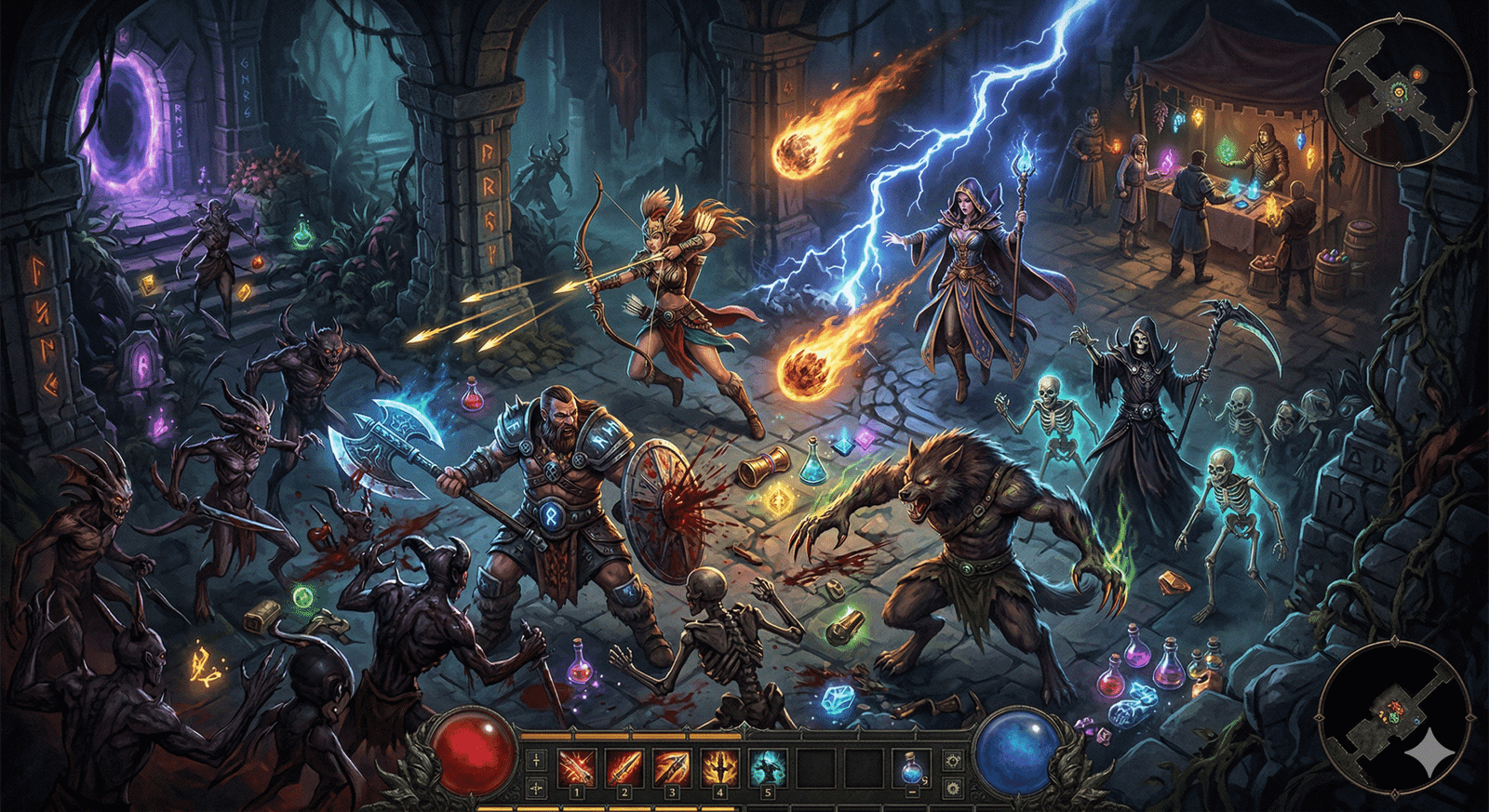
The gaming world is currently witnessing a massive shift. For years, players have poured thousands of hours into virtual worlds, only to leave with nothing but memories when the servers shut down. Today, a new wave of technology is changing that narrative. Seraph games, specifically the flagship title Seraph: In the Darkness, are leading a revolution by combining the addictive “loot-crawl” mechanics of classic action RPGs (ARPGs) with the tangible ownership of blockchain technology.
This isn’t just another crypto project; it is a high-budget, “AAA” quality experience incubated by industry veterans from Actoz Soft the creators of legendary titles like Legend of Mir. By bridging the gap between traditional Web2 gaming fun and Web3 economic freedom, Seraph offers a solution to the “wasted time” problem in gaming. In this comprehensive guide, we will dive into everything you need to know about the Seraph universe, from character classes to the thriving player-driven economy.
What Are Seraph Games?
Seraph games represent a new genre of “Loot-to-Earn” titles. Developed by Seraph Studio, the primary focus is on Seraph: In the Darkness, a 3D dark-fantasy ARPG. Unlike many early blockchain games that were simple and lacked depth, Seraph prioritizes high-fidelity graphics and complex combat systems.
- Core Genre: Action Role-Playing Game (ARPG).
- Theme: Dark Medieval Fantasy.
- Key Innovation: Digital asset ownership through NFTs.
The Legacy of Actoz Soft
The pedigree behind Seraph is what sets it apart from the competition. Seraph Studio is a subsidiary of Actoz Soft, a South Korean gaming giant listed on the KOSDAQ since 2001. This partnership ensures that the game has the technical backing and creative vision needed to compete with industry titans.
- Experience: Over 20 years in MMO development.
- Famous IPs: Legend of Mir, Dragon Nest, and La Tale.
- Team Size: Over 60 specialized developers and blockchain experts.
Core Gameplay Mechanics
At its heart, Seraph is a classic isometric slasher. You enter dark, procedurally generated dungeons, fight hordes of demonic entities, and collect loot to power up your hero. The game loop is designed to be familiar to fans of the Diablo series but adds a layer of economic strategy.
- Combat: Real-time, skill-based fighting.
- Loot System: Thousands of gear variations with random “affixes.”
- Progression: Level up your character and distribute stat points into Strength, Dexterity, Vitality, and Energy.
Choosing Your Hero Class
Your journey begins with selecting a class. Each class offers a distinct playstyle, ensuring that every player finds a strategy that fits their preference. Whether you like getting up close or casting spells from afar, there is a hero for you.
| Class | Primary Attribute | Playstyle | Key Weapons |
| Barbarian | Strength | Melee Tank | Axes, Maces |
| Valkyrie | Dexterity | Ranged DPS | Bows, Spears |
| Sorceress | Energy | Magic/Elemental | Staves, Wands |
| Necromancer | Energy | Summoning/Poison | Scythes |
| Druid | Vitality | Shapeshifting | Natural Magic |
Understanding the Web3 Integration
Seraph games use the blockchain to ensure that the rare items you find are truly yours. Through the ActPass wallet system, players can “mint” their equipment into NFTs. This allows you to sell your hard-earned loot on a secondary market for real value.
- NFT Equipment: Rare gear that can be traded.
- Transparency: All high-value transactions are recorded on the BNB Chain or Ethereum.
- Accessibility: You can play the game for free without needing a wallet initially.
The $SERAPH Token Economy
The lifeblood of the ecosystem is the $SERAPH token. This utility token is used for everything from upgrading equipment to participating in the game’s governance. With a fixed supply of 1 billion tokens, the economy is designed for long-term sustainability rather than short-term speculation.
- Use Cases: Reforging gear, revealing hidden item stats, and voting in the DAO.
- Earning: Rewards from PvP leaderboards and high-level Void Realm dungeons.
- Network: Operates across multiple chains for better liquidity.
Exploring the Void Realms
The “End Game” of Seraph revolves around the Void Realms. These are high-stakes dungeons that require specific tickets to enter. The difficulty is much higher here, but the rewards including the chance to find Genesis NFTs are significantly better.
- Tiers: Higher tier tickets lead to more dangerous bosses.
- Affixes: Maps can have random modifiers that make them harder but more rewarding.
- Team Play: While solo play is possible, the highest levels often require a coordinated party.
Play-to-Earn vs. Play-and-Earn
Seraph moves away from the “Play-to-Earn” (P2E) model that failed many early games. Instead, it focuses on “Play-and-Earn.” The goal is to make the game fun first; the ability to earn is a natural byproduct of being a skilled and dedicated player.
- Skill-Based: Better players earn more through leaderboards.
- Market-Driven: The value of items is determined by the player community, not the developers.
- Free-to-Play Friendly: You can reach the level cap and find valuable items without spending a dime.
The Marketplace and Trading
The Seraph marketplace is a bustling hub where players trade Soul Spars (in-game currency) and NFT equipment. Because everything is decentralized, the developers cannot “delete” your items or prevent you from selling them.
- Soul Spars: The main trading currency used for small transactions.
- ActPass Integration: A seamless mobile-friendly marketplace that doesn’t require complex crypto knowledge.
- Economy Stability: Seasonal “burn” mechanics help keep the item supply in check.
PvP and Competitive Leaderboards
For those who crave competition, Seraph offers robust PvP (Player vs. Player) modes. Testing your build against other humans is the ultimate proof of your character’s power. Seasonal rewards often include large pools of $SERAPH tokens for top-ranked players.
- Ladder System: Ranked matches based on skill and gear.
- Class Balance: Regular updates ensure that no single class dominates the meta.
- Tournament Prizes: Recent seasons have featured prize pools exceeding $800,000.
Customization and Character Growth
Beyond just leveling up, Seraph offers deep customization through its skill trees and equipment “affixes.” Every piece of gear has the potential to be unique, allowing for highly specialized “builds” that can clear content in different ways.
- Skill Trees: Unlock powerful active and passive abilities.
- Reforging: Use materials to change the stats on your favorite items.
- Gems and Jewels: Socket items with magical stones to add elemental damage or resistances.
Security and Account Management
One of the biggest hurdles in tech-heavy games is security. Seraph solves this with ActPass, an MPC (Multi-Party Computation) wallet. It allows you to log in with simple credentials like your email while still maintaining high-level security over your digital assets.
- No Private Keys: You don’t have to worry about losing a 12-word seed phrase.
- Cross-Platform: Manage your assets on PC or mobile.
- Secure Transactions: Every trade is verified to prevent fraud.
Future Roadmap and Seasonal Content
Seraph is built on a seasonal model. Every few months, a new season begins, bringing fresh mechanics, new equipment, and a reset of the competitive ladders. This keeps the gameplay loop fresh and prevents veteran players from becoming too powerful for newcomers to compete.
- Updates: Regular patches add new zones, monsters, and classes (like the recent Druid).
- Community Events: Special limited-time quests with unique cosmetic rewards.
- Governance: $SERAPH holders can vote on future game directions.
Seraph vs. Traditional ARPGs
How does Seraph compare to giants like Diablo IV or Path of Exile? While the core gameplay is very similar, the underlying philosophy of ownership is the differentiator.
| Feature | Traditional ARPGs | Seraph Games |
| Ownership | Assets owned by the company | Assets owned by the player |
| Trading | Often restricted or “soulbound” | Completely free and open |
| Monetization | Microtransactions / Battle Pass | Player-driven NFT economy |
| Value | Purely entertainment | Entertainment + Asset Value |
How to Start Your Journey
Getting started in the Seraph universe is simple. You can download the client for Windows or Android directly from the official website. Once installed, simply create an account, pick your class, and begin your descent into the darkness.
- Step 1: Download the game and the ActPass app.
- Step 2: Complete the tutorial missions to learn basic combat.
- Step 3: Join a guild to find players to help you through early dungeons.
Comparison of Seraph Game Statistics (Season 0 Data)
Note: During the initial testing phases, Seraph saw explosive growth, proving the demand for high-quality blockchain games.
- Total Players: 90,000+
- Peak Concurrent Users: 7,500
- Total NFT Trading Volume: 17,000+ ETH ($42 Million+)
- BNB Chain Ranking: #1 Game DApp by transaction volume.
FAQs
Can I play Seraph games for free?
Yes, Seraph is a free-to-play title. You can download the game, create a character, and play through the entire story without spending money. Earning potential increases if you find rare items or participate in high-level PvP, but an initial investment is not required.
What platform can I play Seraph on?
Currently, Seraph: In the Darkness is available for Windows PC and Android. The developers have plans to expand the game to other platforms, including Steam and potentially iOS, in future updates.
Do I need to know about crypto to play?
Not at all. The game is designed to look and feel like a traditional ARPG. While the underlying technology uses blockchain, the ActPass system makes it easy to manage your assets using a standard email login, hiding the complexity of wallets and private keys.
What is the $SERAPH token?
$SERAPH is the main utility and governance token of the ecosystem. It is used to upgrade gear, participate in seasonal events, and vote on the future of the game through the DAO (Decentralized Autonomous Organization).
How do I earn money in Seraph?
Players can earn by finding rare equipment that can be minted into NFTs and sold on the marketplace. Additionally, participating in seasonal PvP ladders and completing high-level “Void Realm” dungeons provides rewards in the form of tokens and valuable loot.
Is the game difficult?
Seraph offers a scaling difficulty. The early story is accessible for casual players, while the end-game content and “Chaos” dungeons are designed to challenge even the most experienced ARPG veterans.
Is my progress saved across seasons?
While your character’s level and some stats may reset with a new season (standard for ARPGs), your NFT equipment and tokens stay in your ActPass wallet, allowing you to carry your value forward or trade it as you see fit.
Conclusion
Seraph games are proving that the future of the industry lies in the perfect marriage of high-quality entertainment and digital ownership. By utilizing the deep experience of Actoz Soft and the transparency of blockchain, Seraph: In the Darkness has created a sustainable ecosystem where a player’s time is truly valued. Whether you are a hardcore fan of dark-fantasy loot crawlers or a tech enthusiast looking for the next big thing in Web3, Seraph offers a world that is as rewarding as it is dangerous.
As the industry moves toward more decentralized models, those who join the Seraph community early will find themselves at the forefront of a new era. The gates to the Void are open will you step through and claim your destiny?