The modern financial ecosystem is no longer a monolith of “banks” and “merchants.” As digital transformation accelerates, the granularity with which we categorize businesses determines the success of payment processing, credit scoring, and targeted marketing. One of the most critical frameworks emerging in the Indian and global fintech landscape is the RetailPe business vertical classification. This system isn’t just about labeling a shop; it’s about a multi-dimensional approach to understanding a business’s DNA its risk profile, transaction frequency, and regulatory needs.
For entrepreneurs and fintech analysts, mastering this classification is the key to unlocking seamless integrations and optimized revenue streams. By aligning with specific vertical markers, businesses can access tailored financial products that a “one-size-fits-all” model simply cannot provide. This article explores the depths of how RetailPe and similar platforms structure these categories to drive efficiency in the digital economy.
Defining RetailPe Business Vertical Classification
The RetailPe business vertical classification serves as the structural backbone for merchant onboarding and service delivery. It is a hierarchical system that groups businesses into specific industries based on their operational nature and consumer interaction.
- Granular Identification: Moves beyond simple “Retail” to identify sub-sectors like FMCG, Apparel, or Electronics.
- Operational Alignment: Ensures the payment gateway features match the business needs (e.g., subscription models for gyms vs. instant checkout for grocery).
- Regulatory Compliance: Helps in assigning the correct Merchant Category Code (MCC) for tax and banking regulations.
The Significance of Verticality in Modern Fintech
Classification is no longer a back-office administrative task; it is a strategic lever. In the world of RetailPe, knowing the vertical allows for “intelligent routing” of transactions.
- Risk Management: Different verticals have different chargeback rates; classification helps in fraud detection.
- Customized Fee Structures: High-volume, low-margin businesses (like Kirana stores) receive different MDR rates than luxury boutiques.
- Targeted Lending: Lenders use these classifications to offer working capital loans tailored to specific seasonal cycles.
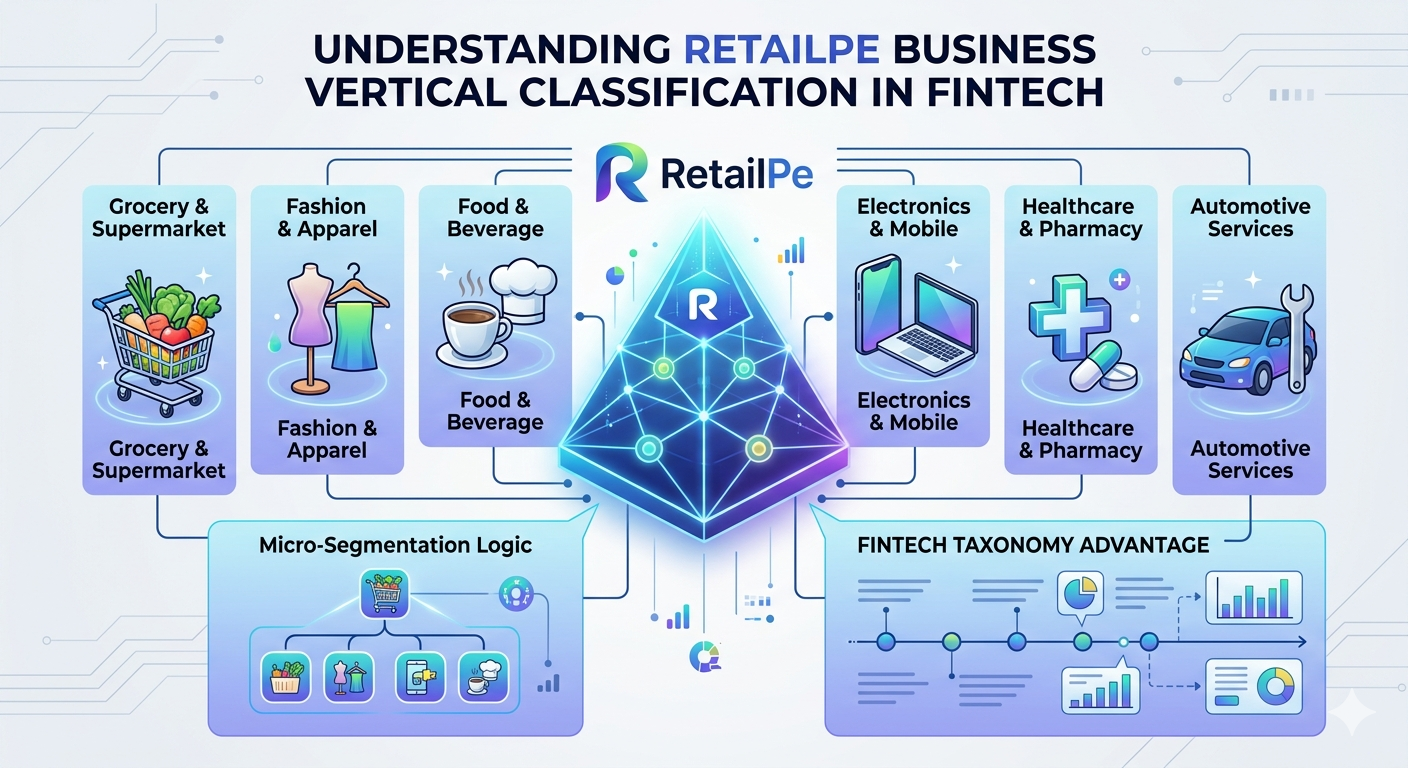
Core Categories within RetailPe Ecosystem
RetailPe typically breaks down the massive retail landscape into manageable segments. These core categories ensure that the user interface of the merchant app remains relevant.
- Food and Beverage (F&B): Includes restaurants, cafes, and bakeries.
- Essential Services: Pharmacies, grocery stores, and daily utility providers.
- Lifestyle & Fashion: Clothing, footwear, and accessory boutiques.
- Specialized Retail: Hardware stores, bookstores, and electronics hubs.
Hierarchy and Sub-Vertical Logic
A “one-level” classification is rarely sufficient for complex data analysis. RetailPe uses a nested approach to ensure high-resolution data.
- Level 1 (Sector): The broad industry (e.g., Healthcare).
- Level 2 (Vertical): The specific niche (e.g., Diagnostic Labs).
- Level 3 (Sub-Vertical): Precise service type (e.g., Radiology center).
- Data Integrity: This hierarchy prevents overlap and ensures clean reporting for business owners.
Technology Stack Driving Classification
The “Tech” in Fintech is what makes modern classification dynamic rather than static. RetailPe utilizes AI-driven engines to verify if a merchant belongs to their claimed vertical.
- Automated Verification: Using GSTIN and business licenses to cross-reference categories.
- NLP Analysis: Analyzing business names and descriptions to suggest the most accurate vertical.
- Machine Learning: Improving the classification engine as more data points are collected from millions of transactions.
RetailPe Business Vertical Classification vs. Traditional SIC Codes
Traditional systems like SIC or NAICS were built for the industrial age. Modern fintech requires something more agile that understands digital-first businesses.
| Feature | Traditional (SIC/NAICS) | RetailPe Classification |
| Update Frequency | Every few years | Real-time / Dynamic |
| Granularity | Broad / Industrial | Niche / Consumer-centric |
| Fintech Integration | Low (Paper-heavy) | High (API-driven) |
| Purpose | Statistical / Tax | Operational / Growth |
Impact on Merchant Onboarding (KYB)
The Know Your Business (KYB) process is significantly faster when a clear classification system is in place. It streamlines the “approval-to-transaction” pipeline.
- Pre-defined Documentation: Different verticals require different licenses; the system automatically asks for the right ones.
- Reduced Manual Intervention: Standardized categories allow for automated risk assessments.
- Faster Settlement: Certain low-risk verticals can be “fast-tracked” for immediate payment settlements.
Data-Driven Insights for Retailers
For the merchant, being part of a specific RetailPe business vertical classification means receiving better analytics. It’s about comparing apples to apples.
- Benchmarking: A grocery store can see how its growth compares to other grocery stores in the same region.
- Consumer Behavior: Understanding the average ticket size specific to the “Luxury Watch” vertical.
- Inventory Suggestions: Predictive analytics based on vertical-specific trends (e.g., peak seasons for school supplies).
Regulatory Compliance and MCC Codes
Merchant Category Codes (MCC) are four-digit numbers used by credit card companies to classify a business. RetailPe maps its internal verticals to these global standards.
- Tax Categorization: Ensuring GST rates are applied correctly based on the business type.
- Incentive Programs: Allowing banks to offer “cashback” on specific verticals like “Fuel” or “Dining.”
- Global Interoperability: Ensuring local Indian merchants can accept international cards without technical friction.
The Role of LSI Keywords in Vertical Discovery
In the information niche, searching for “RetailPe business vertical classification” often involves related terms that define the ecosystem.
- Related Concepts: Merchant Category Codes, Fintech Taxonomy, Business Segmentation, and Payment Verticalization.
- Search Intent: Users looking for this are often trying to integrate a payment gateway or optimize their business listing.
- Strategic Advantage: Using these terms ensures that the merchant’s digital footprint is visible to the right financial partners.
Customizing the Payment Experience
A clothing store and a cinema hall have very different customer journeys. Vertical classification allows RetailPe to customize the checkout interface.
- Dynamic Checkouts: Adding fields for “Table Number” in the F&B vertical.
- Loyalty Integration: Automatically triggering “Buy 10 Get 1 Free” for the coffee shop vertical.
- Invoice Generation: Tailoring the digital receipt to include vertical-specific details like HSN codes.
Case Study: Transforming a Local Kirana Store
A traditional grocery store in a Tier-2 city integrated with the RetailPe ecosystem. By correctly identifying under the “Essential Grocery” vertical, the transformation was immediate.
- The Problem: The owner was charged high rates applicable to “Electronics” due to poor initial classification.
- The Solution: Re-classification into the correct vertical lowered their MDR by 0.5%.
- The Result: The merchant gained access to a specialized “Micro-Credit” line designed specifically for small grocery restocking cycles.
Challenges in Business Classification
Despite the technology, classifying every unique business remains a challenge due to the “hybrid” nature of modern commerce.
- Omnichannel Ambiguity: A shop that is 50% cafe and 50% bookstore (How do you classify it?).
- Evolution of Niche: New categories like “Cloud Kitchens” or “D2C Brands” require constant updates to the classification engine.
- Merchant Misrepresentation: The risk of merchants choosing “low-risk” categories to get lower fees.
Future Trends in Fintech Taxonomy
The future of RetailPe business vertical classification lies in “Micro-Segmentation.” We are moving from 50 categories to 5,000.
- Hyper-local Categories: Classifications that account for regional business variations.
- Behavioral Classification: Moving from “what you sell” to “how your customers pay.
- Blockchain Integration: Immutable records of a business’s vertical history to prevent fraud.
Leveraging Verticals for Marketing Success
Once a business is classified, marketing becomes a precision tool rather than a shotgun approach.
- Segmented Campaigns: RetailPe can send “Bakery Day” promotions only to merchants in the F&B vertical.
- Partnership Opportunities: Connecting organic farmers (Supply) with stores in the “Organic Retail” vertical (Demand).
- Value-Added Services: Offering insurance products specifically designed for “Jewelry Retailers.”
Comparing Vertical vs. Horizontal Business Models
Understanding the difference between these two models is crucial for anyone studying the RetailPe ecosystem.
- Horizontal: Broad reach across many industries (e.g., a general cloud hosting service).
- Vertical: Deep focus on a specific industry (e.g., a payment gateway exclusively for “Education Fees”).
- RetailPe’s Strategy: It acts as a horizontal platform that provides highly verticalized solutions for each merchant.
Optimizing Your Business Profile for RetailPe
For merchants, being categorized correctly is a form of SEO for the financial world.
- Use Precise Keywords: In your business description, use terms that clearly define your vertical.
- Keep Documents Ready: Ensure your trade license matches your requested category.
- Regular Updates: If your business pivots (e.g., from a restaurant to a catering service), update your classification immediately to avoid compliance issues.
How does RetailPe decide my business vertical?
The system uses a combination of your provided business description, your GST/Registration documents, and your initial transaction patterns to suggest the most accurate vertical.
Can I change my business vertical classification later?
Yes, you can request a re-classification through the RetailPe dashboard if your business model has changed or if you were initially categorized incorrectly. This may require updated documentation.
Does the vertical classification affect my transaction fees?
In many cases, yes. Fintech providers often have different Merchant Discount Rates (MDR) for different sectors. For instance, non-profit or government categories often have lower rates than high-risk retail sectors.
What is the difference between a vertical and an MCC code?
A business vertical is a user-friendly way to describe your industry (e.g., “Pharmacy”), whereas an MCC code is a standardized 4-digit number used by the banking industry (e.g., 5912 for Drug Stores and Pharmacies).
Why is my business classified as “Miscellaneous”?
This usually happens when the business description is too vague or doesn’t fit into the primary categories. It is best to update this to a specific vertical to unlock better analytics and features.
Do vertical classifications help in getting loans?
Absolutely. Lenders use vertical data to understand your industry’s health. A “seasonal” business like a toy store is evaluated differently than a “steady” business like a grocery store.
Is RetailPe’s classification system available globally?
While RetailPe focuses heavily on the Indian market and its specific nuances (like Kirana stores), the logic of its classification follows global fintech standards, making it compatible with international systems.
Conclusion: The Power of Precision
The RetailPe business vertical classification is far more than a dropdown menu; it is the fundamental logic that dictates how money flows through a digital merchant’s account. By creating a structured, data-rich environment, RetailPe enables small businesses to compete with giants by providing them with the exact financial tools they need for their specific niche.
As we move further into a world of specialized commerce, the ability to accurately define a business vertical will be the difference between a struggling enterprise and a flourishing one. Whether you are a developer building on the platform or a merchant looking to optimize your fees, understanding this classification is your first step toward long-term digital success.