
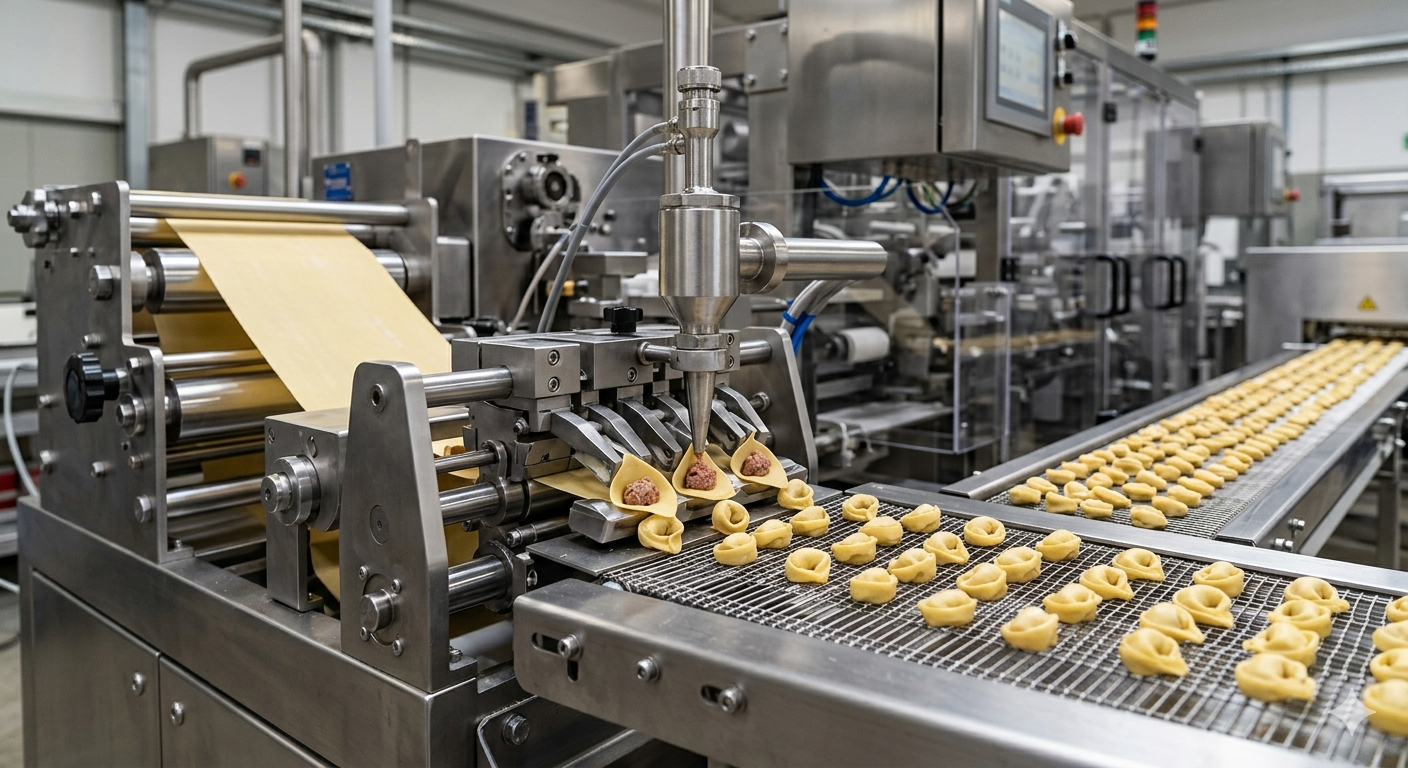
In the intersection of artisanal heritage and cutting-edge food technology lies a marvel of mechanical engineering: the tortellinatrice. Historically, the art of folding tortellini was a labor-intensive ritual passed down through generations of Italian sfogline. However, as global demand for fresh, filled pasta has surged, the industry has turned to sophisticated automation to bridge the gap between tradition and scale. Today, the tortellinatrice is not just a machine; it is a pinnacle of precision engineering designed to replicate the delicate human touch at industrial speeds.
As we navigate the landscape of 2026, the significance of this technology has transcended the kitchen. It now plays a vital role in the global food supply chain, ensuring consistency, safety, and efficiency. Whether you are a food tech enthusiast, a commercial pasta producer, or a culinary professional, understanding the mechanics and digital integration of the modern tortellinatrice is essential. This article offers a comprehensive deep dive into the evolution, technical specifications, and market dynamics of these machines, providing actionable insights into how automation is preserving rather than erasing the soul of Italian cuisine.
Understanding the Core Concept of a Tortellinatrice
A tortellinatrice is a specialized industrial or professional-grade machine designed to automate the production of tortellini, tortelloni, and cappelletti. Unlike standard pasta extruders, these units focus on the complex “fold and pinch” movement required for filled pasta.
- Primary Function: It transforms flat pasta sheets and bulk filling into individual, sealed ring-shaped units.
- Mechanical Precision: Uses synchronized cams and rollers to mimic the manual closing of the dough around the filling.
- Versatility: Most modern units allow for adjustable filling quantities and dough thicknesses.
The Technical Anatomy of Modern Tortellini Machines
The internal architecture of a tortellinatrice is a masterclass in synchronized motion. To achieve a “handmade” look, the machine must manage several high-precision tasks simultaneously without tearing the delicate dough.
- Dosing Pump: A piston or continuous screw system that injects precise milligrams of filling.
- Forming Group: A series of molds and mechanical “fingers” that fold the pasta sheet.
- Scrap Recovery: Integrated systems that collect and recycle the leftover dough (sfrido) for efficiency.
Why Automation is Essential for Fresh Pasta Tech
In the information-driven food sector, data points to a massive shift toward “fresh-frozen” logistics. A manual worker might produce 60 pieces per minute, but a high-end tortellinatrice can produce thousands.
- Scalability: Allows local shops to expand into regional supermarket distribution.
- Microbial Control: Minimizing human contact reduces the risk of contamination in fresh fillings.
- Labor Efficiency: Shifts the workforce from repetitive manual labor to technical oversight and quality control.
Integrating IoT and Smart Sensors in Food Production
The latest generation of tortellinatrice hardware is now part of the Internet of Things (IoT). Manufacturers are embedding sensors to monitor machine health in real-time, preventing costly downtime.
- Predictive Maintenance: Sensors track motor heat and vibration to alert operators before a failure occurs.
- Quality Metrics: Digital cameras use AI to identify and reject malformed tortellini automatically.
- Remote Calibration: Technicians can adjust machine timing via cloud-based interfaces.
Comparing Manual vs. Automatic Production Capacities
When deciding between traditional methods and a tortellinatrice, the numbers tell a compelling story. The ROI (Return on Investment) for automation is often realized within the first year of high-volume production.
| Feature | Manual Production (1 Person) | Industrial Tortellinatrice |
| Output (Pieces/Hour) | ~300 – 500 | 5,000 – 15,000+ |
| Consistency | Variable (Human Error) | 99.9% Uniformity |
| Filling Accuracy | Visual Estimate | Digital Piston Precision |
| Hygienic Risk | High (Hand Contact) | Low (Stainless Steel Path) |
The Role of Stainless Steel in Food Safety Standards
Material science is critical in the construction of a tortellinatrice. To meet international health standards (like NSF or CE), manufacturers use specific alloys that resist corrosion and bacterial growth.
- AISI 304/316 Steel: The industry standard for all parts in contact with pasta and meat fillings.
- Atoxic Materials: Moving parts and gaskets are made from food-grade polymers that do not leach chemicals.
- Wash-Down Capability: Designed for high-pressure cleaning without damaging the electronic brain.
Precision Filling: The Science of Dosing
The most difficult part of using a tortellinatrice is managing the “filling-to-dough” ratio. If the filling is too wet, the dough tears; if it’s too dry, the machine jams.
- Volumetric Dosing: Ensures every tortellino has the exact same weight, crucial for nutritional labeling.
- Texture Management: Advanced pumps can handle chunky fillings (like minced prosciutto) without clogging.
- Variable Speed: Operators can adjust the filling rate on-the-fly via a PLC (Programmable Logic Controller) touchscreen.
Sizing and Footprint: From Countertop to Factory Floor
Not every tortellinatrice is a giant industrial behemoth. The market has diversified to provide solutions for various business scales, from boutique delis to global exporters.
- Tabletop Models: Compact units designed for restaurants making 10-20kg of pasta daily.
- Modular Lines: Middle-market machines that can be connected to pasteurizers and cooling tunnels.
- High-Speed Industrial: Massive systems capable of running 24/7 with minimal supervision.
The Evolution of Forming Molds and Shapes
A common misconception is that a tortellinatrice can only make one shape. Modern engineering allows for interchangeable “forming groups” that can be swapped in minutes.
- Interchangeability: Switch between small “Venus Navel” tortellini and larger tortelloni.
- Customization: Brands can order custom molds to create unique, signature pasta shapes.
- Edge Design: Options for serrated or smooth edges depending on regional traditions.
Waste Reduction and Sustainability in Pasta Making
Sustainability is a key metric in 2026. The tortellinatrice is designed to minimize food waste, which is both environmentally friendly and economically sound.
- Dough Recycling: 100% of the “web” (excess dough) is fed back into the extruder.
- Energy Efficiency: New brushless motors consume up to 30% less electricity than older induction models.
- Reduced Packaging Waste: Uniform products allow for tighter, more efficient packaging dimensions.
Digital Controls and User Interface Design
Gone are the days of manual cranks and oily levers. The modern tortellinatrice is operated via intuitive HMI (Human-Machine Interface) screens that look like high-end tablets.
- Recipe Storage: Save settings for different dough types (egg-based, spinach, or gluten-free).
- Multi-Language Support: Enables global teams to operate the machinery with minimal training.
- Error Logging: Diagnostics help troubleshoot issues without needing a mechanical engineer on-site.
Market Trends: The Rise of Fresh-Filled Pasta
The global market for pasta machinery is expanding. As consumers move away from dried, boxed pasta toward premium “fresh” options, the demand for the tortellinatrice has spiked.
- Asia-Pacific Growth: A massive increase in demand for Italian-style filled pasta in urban China and Japan.
- North American Artisanal Movement: Small-scale producers using industrial tech to create “craft” pasta.
- Direct-to-Consumer: More businesses are using these machines to fulfill online “pasta kit” subscriptions.
Maintenance and Longevity of Industrial Equipment
A high-quality tortellinatrice is a 20-year investment. Proper maintenance is the difference between a profitable asset and a mechanical liability.
- Daily Sanitation: Essential for preventing cross-contamination between batches.
- Lubrication Schedules: Automated systems that oil internal gears to prevent friction wear.
- Annual Calibration: Ensures the timing of the folding fingers remains within a fraction of a millimeter.
Training and Skill Acquisition for Operators
While the tortellinatrice does the heavy lifting, the “human in the loop” remains vital. Technicians must understand the chemistry of the dough to feed the machine correctly.
- Dough Elasticity: Operators must adjust moisture levels based on room temperature and humidity.
- Mechanical Fluency: Basic understanding of how to swap molds and clear jams.
- Safety Protocols: Strict adherence to “lock-out tag-out” procedures during cleaning.
Case Study: The “Pasta Factory 4.0” Model
Recent implementations in Northern Italy showcase the power of fully integrated lines. A factory utilizing five tortellinatrice units saw a 400% increase in output with zero increase in labor costs.
- The Setup: Automated flour silos feeding an extruder, which feeds the tortellinatrici directly.
- The Result: A closed-loop system where dough is never touched by human hands until the consumer opens the package.
- Sustainability: Water used for cooling the motors was recycled for factory heating.
Cost-Benefit Analysis for Small Businesses
For a small trattoria, the jump to a tortellinatrice is a major decision. However, when calculating the “per-unit” cost of labor, the machine usually pays for itself.
- Labor Savings: Replaces 3-4 specialized pasta makers.
- Menu Expansion: Allows for a wider variety of filled specials without overtaxing the kitchen.
- Standardization: Ensures the customer gets the same experience whether they visit on Tuesday or Saturday.
Future Outlook: AI and Neural Networks in Shaping
The future of the tortellinatrice involves “Adaptive Shaping.” Imagine a machine that adjusts its pinch-pressure based on the gluten strength of the specific flour batch it’s processing.
- Computer Vision: Detecting air pockets in filling before the pasta is even folded.
- Autonomous Tuning: Machines that “learn” the optimal speed for different filling viscosities.
- Eco-Packaging Integration: Direct output into biodegradable, vacuum-sealed containers.
Regulatory Landscape and Global Export Standards
Shipping a tortellinatrice internationally requires strict adherence to safety and electrical regulations.
- CE Marking: Required for all units sold within the European Economic Area.
- UL Certification: Essential for the North American market to ensure electrical safety.
- Food Grade Certs: Documentation proving that all plastics and metals are safe for human consumption.
FAQs
How much does a professional tortellinatrice cost?
Prices vary significantly based on capacity. Small tabletop models can start around $5,000–$8,000, while industrial-scale production lines can exceed $100,000 depending on automation features and output volume.
Can a tortellinatrice handle gluten-free dough?
Yes, but it requires careful calibration. Gluten-free dough is often less elastic and more prone to tearing, so modern machines often feature specialized rollers and slower cycle speeds to accommodate these delicate mixtures.
How often does the machine need cleaning?
In a commercial environment, a tortellinatrice must be cleaned at the end of every production shift. Most parts in contact with food are designed to be removed quickly for deep sanitization to meet health codes.
Is it difficult to change the shapes on a tortellinatrice?
Not with modern modular designs. Most machines allow you to swap the “forming group” in about 15–30 minutes, allowing a single machine to produce tortellini, tortelloni, and other shapes in the same day.
What is the average production speed?
Standard professional models typically produce between 30kg and 100kg of pasta per hour. Large-scale industrial units can reach speeds of 300kg/hour or more, depending on the size of the tortellino.
Does the machine require a special electrical setup?
Most professional and industrial models require three-phase power (220V or 380V). However, smaller “boutique” models are increasingly available in standard single-phase configurations for smaller kitchens.
Can I use my own family recipe in the machine?
Absolutely. The key is adjusting the consistency of your filling and dough to be “machine-friendly” usually meaning a smoother filling texture and a dough with specific moisture content (typically around 30-32%).
Conclusion: The Future of Culinary Tech
The tortellinatrice represents more than just industrial progress; it is a bridge between the cherished culinary traditions of the past and the technological demands of the future. By automating the most difficult and repetitive aspects of pasta making, these machines allow chefs and producers to focus on what truly matters: flavor, ingredient quality, and culinary innovation.
In an era where “fresh” and “authentic” are the most valuable labels in the food industry, the ability to produce high-quality filled pasta at scale is a significant competitive advantage. The integration of IoT, AI-driven quality control, and sustainable engineering has turned the tortellinatrice into a high-tech asset that preserves the integrity of the tortellino while making it accessible to a global audience.
Whether you are looking to start a boutique pasta brand or optimize a massive production facility, the tortellinatrice is the definitive tool for the job. As we look toward the remainder of the decade, we can expect even more integration between digital systems and mechanical precision, ensuring that the “perfect fold” is no longer a rare luxury, but a standard of excellence available to everyone. Explore the latest models from reputable manufacturers today and take the first step toward revolutionizing your pasta production workflow.