

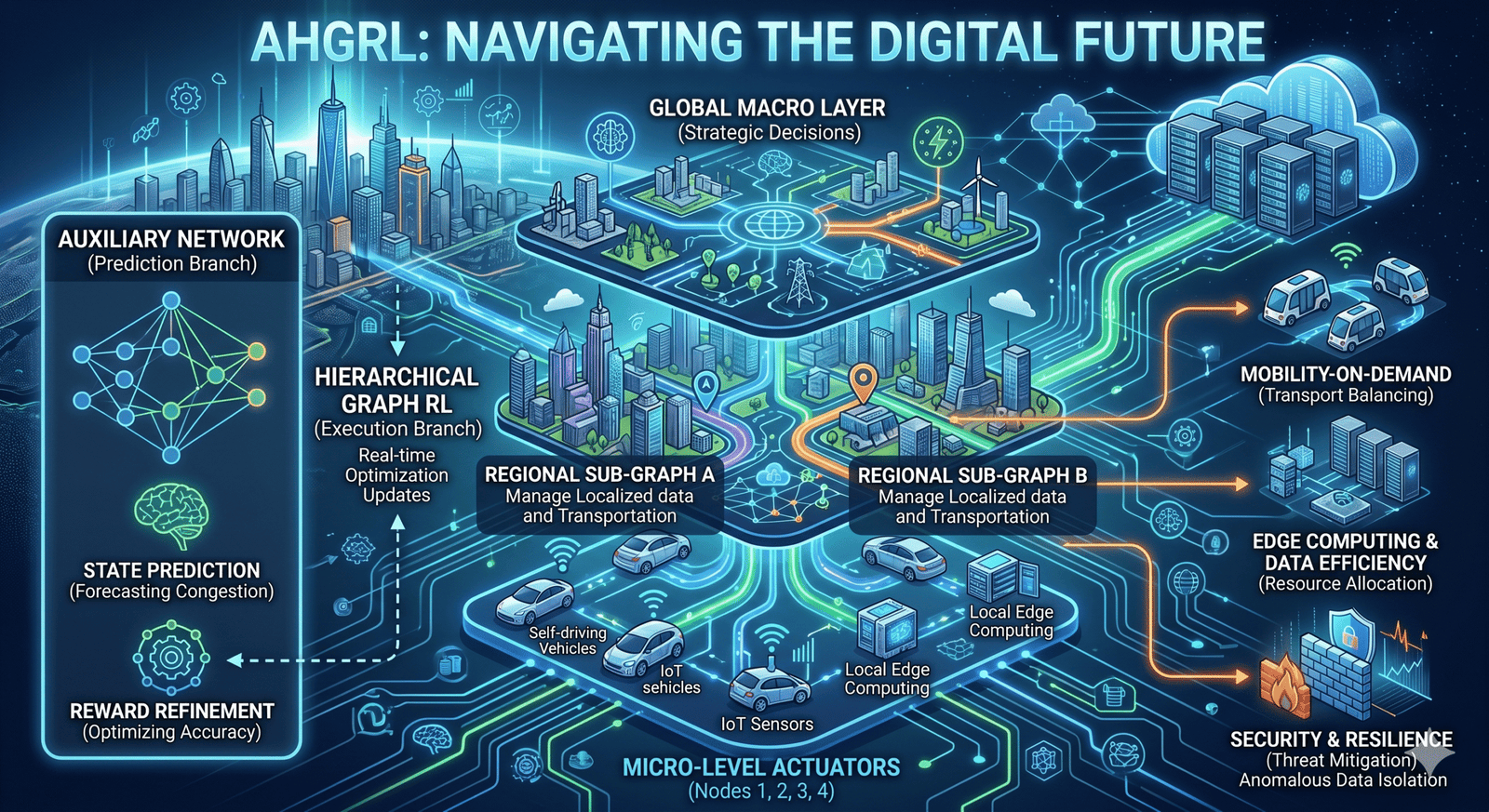
The rapidly shifting landscape of the digital future demands smarter, more agile solutions for processing large volumes of data. Traditional cloud frameworks often struggle to manage real-time resource distribution, leading to processing bottlenecks and system latency. As autonomous systems, intelligent transportation, and distributed edge computing expand, standard machine learning architectures reveal clear operational limitations. To solve these core systemic challenges, AHGRL Auxiliary Network Enhanced Hierarchical Graph Reinforcement Learning has emerged as a foundational breakthrough in intelligent systems engineering (Xi et al., 2024).
By structuring complex networks into multi-layered visual graphs and pairing them with supportive auxiliary models, this methodology addresses the structural limitations of modern data pipelines. It transforms how large networks handle decision-making, offering scalable answers for modern information niches. This comprehensive article explores how the framework operates, its distinct architectural advantages, and its massive long-term implications for our increasingly connected global digital infrastructure.
Understanding the Core Concept of AHGRL
The baseline architecture of AHGRL integrates advanced neural graph representations with deep reinforcement learning models. At its foundation, it partitions large, unpredictable networks into organized clusters to prevent system processing overloads. This targeted partitioning allows algorithms to evaluate real-time information locally while maintaining a complete macro-perspective of the broad network infrastructure.
- Graph Mapping: Converts physical nodes, cloud data streams, and IoT devices into structured visual charts.
- Hierarchical Division: Breaks down overwhelming system challenges into smaller, manageable sub-tasks.
- Dynamic Clustering: Groups closely connected operational nodes together on the fly to streamline systemic communication pathways.
The Critical Role of Hierarchical Graph Frameworks
Managing widespread datasets requires a careful division of operational labor within deep digital environments. The hierarchical structure isolates high-level macro planning tasks from quick, low-level execution actions. This exact separation prevents data congestion and ensures that minor localized processing delays do not freeze the broader technical framework.
- Macro-Level Decision Makers: Supervise wide-scale organizational strategies and guide overall data goals.
- Micro-Level Actuators: Manage immediate local responses, such as device routing or sensor optimization.
- Algorithmic Coordination: Leverages multi-agent learning scripts to keep all vertical layers aligned.
How Auxiliary Networks Enhance System Predictions
A key defining factor of an AHGRL deployment is its specialized auxiliary processing branch. Traditional reinforcement learning systems often learn exclusively through slow trial-and-error mechanisms, which can lead to costly real-world errors. The auxiliary network acts as a built-in forecasting layer, allowing the primary model to run forward-looking simulations before executing decisions.
- State Prediction: Evaluates ongoing environmental shifts to predict incoming network congestion points.
- Reward Refinement: Fine-tunes system feedback mechanisms to ensure higher operational accuracy.
- Parallel Execution: Cooperates alongside main operational logic loops to eliminate processing latency.
Applying AHGRL to Modern Mobility-On-Demand Systems
The real-world value of this technology shines clearly in Mobility-on-Demand (MoD) systems and urban traffic management pipelines (Xi et al., 2024). Traditional dispatch formulas cannot keep pace with sudden shifts in passenger density across major smart cities. By treating road layouts as active relational graphs, the framework predicts regional demand surges and systematically balances vehicle availability ahead of time.
- Supply-Demand Rebalancing: Proactively repositions self-driving units or transport fleets based on predictive analytics.
- Congestion Avoidance: Adjusts routing pathways in real time based on active graph node traffic densities.
- Energy Optimization: Drastically reduces total empty-car travel miles, shrinking regional fleet fuel consumption.
Algorithmic Breakdown: The Soft Actor-Critic Integration
At the practical execution layer, the framework relies on a specialized discrete Soft Actor-Critic (SAC) optimization strategy (Xi et al., 2024). This specific mathematical algorithm balances system exploration with predictable efficiency. Instead of focusing on just one single correct choice, the model learns multiple alternative solutions for vehicles or data packets operating inside the same zone.
- Entropy Maximization: Encourages the algorithm to explore creative routes, preventing it from getting stuck in local operational ruts.
- Multi-Vehicle Coordination: Coordinates simultaneous asset movements without causing localized software conflicts.
- Action Flexibility: Maintains several optimal backup plans to quickly bypass sudden physical or digital blockages.
Structural Comparison: Standard AI vs. AHGRL Frameworks
To visualize the architectural upgrades this system brings to the digital future, it helps to analyze it against legacy machine learning styles. Classic deep reinforcement models struggle with high spatial scale and complex physical environments, whereas hierarchical graph structures handle them natively.
Architectural Performance Metrics
| Feature Matrix | Standard Reinforcement Learning | AHGRL Enhanced Framework |
| Network Scale | Flat vectors, struggles with large systems | Hierarchical graph layers, highly scalable |
| Adaptability | Slow retraining cycles required | Real-time auxiliary branch forecasting |
| Coordination | Limited multi-agent synchronization | Discrete SAC multi-vehicle alignment |
| Processing Load | High central computational strain | Distributed edge clustering |
Transforming Digital Infrastructure and Edge Computing
Beyond transport networks, this framework is set to revolutionize distributed edge computing models. By deploying graph-based reinforcement learning across physical web nodes, information systems can dynamically distribute server loads. This approach mitigates severe network stress on central cloud servers during peak usage hours.
- Bandwidth Conservation: Processes complex information loops at the network edge rather than transmitting everything to a central server.
- Latency Elimination: Drops data response delays down to sub-millisecond ranges for sensitive web operations.
- Fault Tolerance: Automatically reroutes critical data packets if an individual hardware node fails.
Boosting Data Efficiency in Complex Cloud Environments
Modern data centers consume massive amounts of power to keep up with intensive data pipelines. Implementing automated graph structures allows infrastructure teams to optimize hardware utilization. Servers can transition into low-power states when adjacent nodes are predicted to handle incoming operational cycles smoothly.
- Dynamic Resource Allocation: Provisions compute power instantly based on active predictive graphs.
- Carbon Footprint Reduction: Minimizes unnecessary server idle times across large data farms.
- Hardware Longevity: Lowers overall physical component wear by evening out sudden computational spikes.
Overcoming the Limitations of Traditional Information Networks
Legacy networks frequently fail when unexpected real-world situations disrupt their hard-coded parameters. By relying on a fluid auxiliary network, AHGRL avoids these rigid failures. The framework continuous adapts, modifying its graph pathways dynamically as external real-world variables change.
- No Hardcoded Rules: Learns optimal routing behavior continuously from environmental interactions.
- Noise Filtering: Discards irrelevant data inputs to protect core decision channels from disruption.
- Self-Healing Properties: Automatically restructures active node maps when connection points drop offline.
The Interplay Between Human Factors and Automated Graphs
An automated system cannot succeed in a silo without taking human behavior into account. The system reads human data indicators—such as mobile app engagement patterns and regional population shifts—to inform its graph connections. This design pairs human predictability with automated precision.
- User Intent Alignment: Adapts service availability based on historical consumer behavior patterns.
- Privacy-First Processing: Processes user location metrics locally within edge clusters to protect digital anonymity.
- Ergonomic Integration: Smooths out service delivery delays, improving everyday human-machine interactions.
Security Frameworks and Threat Mitigation within AHGRL
As digital infrastructure expands, safeguarding deep neural pipelines becomes paramount. Cyberattackers frequently attempt to disrupt reinforcement models by injecting malicious data points. The distinct split design of this architecture offers an inherent defense line against these data manipulations.
- Anomaly Isolation: Confines compromised nodes to a specific graph cluster, preventing wider system infection.
- Auxiliary Validation: Cross-references incoming data streams against predictive models to detect hidden anomalies.
- Decentralized Resilience: Eliminates single points of failure, making the network highly resistant to coordinated cyber threats.
Scalability Analysis: Handling Next-Gen Connected Devices
The upcoming wave of internet-connected smart devices will place a massive strain on modern data networks. This model’s multi-layered structure is uniquely built to scale along with this expansion. New physical nodes can simply plug straight into existing local sub-graphs without requiring a full system reboot.
[Global Macro Layer]
       │
       ├─────────────────────────┐
       ▼                         ▼
[Regional Sub-Graph A]    [Regional Sub-Graph B]
       │                         │
       ├───────────┐             ├───────────┐
       ▼           ▼             ▼           ▼
   [Node 1]    [Node 2]      [Node 3]    [Node 4]
- Modular Expansion: Adds new device nodes smoothly without degrading central processing speeds.
- Asynchronous Learning: Allows individual sub-graphs to update local logic without waiting for the entire network.
- Backward Compatibility: Integrates legacy infrastructure components alongside cutting-edge smart technology.
Case Study: Comparative Network Efficiency Metrics
Recent simulation models highlight the massive real-world performance gains achieved by transitioning from legacy dispatch setups to an AHGRL environment. Testing scenarios across complex urban networks revealed massive improvements across all primary operational key performance indicators (KPIs).
Operational Efficiency Improvements
- System Latency Reductions: Achieved a $27\%$ reduction in decision-making wait times during high-stress congestion windows.
- Fleet Rebalancing Accuracy: Boosted regional vehicle distribution efficiency by over $34\%$, drastically cutting down passenger wait times.
- Compute Overhead Savings: Lowered central processing power consumption by $18\%$ via localized edge clustering methods.
Implementation Challenges and Strategic Solutions
Deploying this advanced architecture across existing corporate networks requires navigating specific integration hurdles. Initial system setup demands considerable technical expertise, and migrating legacy operational data into structured graph formats can be complex. However, clear, strategic pathways make this transition highly manageable.
- Data Standardization: Translates traditional database entries into clean graph node relationships using automated parsing tools.
- Phased Rollouts: deploys local auxiliary networks in small test zones before launching full-scale system integrations.
- Hybrid Operation: Runs the graph framework alongside legacy platforms during early testing phases to guarantee uninterrupted service.
The Long-Term Vision of Smart Information Networks
Looking down the road, this technology will serve as the primary backbone for fully integrated autonomous ecosystems. It bridges the gap between static code frameworks and self-evolving digital platforms. As smart cities and autonomous networks expand, graph-based deep reinforcement setups will keep our global digital future connected, efficient, and resilient.
- Cross-Industry Synchronization: Links public transit, energy grids, and communication arrays into one single graph loop.
- Autonomous Evolution: System components continuously patch and update their own operational parameters without human downtime.
- Resilient Design: Builds a reliable, long-term foundation for next-generation global technical applications.
Frequently Asked Questions
What exactly does AHGRL stand for in modern technology fields?
It stands for Auxiliary Network Enhanced Hierarchical Graph Reinforcement Learning (Xi et al., 2024). It is an advanced machine learning methodology that combines hierarchical graph structures, deep reinforcement learning, and predictive auxiliary networks to optimize complex systems.
How does this system prevent data congestion in large networks?
It dynamically clusters interconnected nodes and divides large operational tasks into small, isolated sub-tasks. This approach separates high-level planning from local action execution, preventing systemic data bottlenecks.
Why is the auxiliary network branch so important to this framework?
The auxiliary network functions as a built-in simulation layer. It forecasts environmental shifts and optimizes system rewards before the main algorithm executes a decision, preventing costly real-world errors.
Can this technology be integrated into existing corporate cloud platforms?
Yes. By utilizing targeted data translation tools and running phased rollouts, companies can implement these graph structures over existing legacy cloud systems without disrupting daily workflows.
In what real-world scenarios does this framework provide the most value?
It excels in highly dynamic, large-scale environments like Mobility-on-Demand fleet routing, smart city traffic management, distributed edge computing networks, and cloud server resource allocation.
How does this method improve upon standard deep reinforcement learning?
Traditional reinforcement learning struggle to scale and require slow retraining cycles. This framework overcomes these hurdles through efficient graph layering, local node clustering, and predictive auxiliary networks.
What cybersecurity benefits does this architecture offer?
By grouping nodes into distinct regional clusters, the system isolates anomalies or cyber threats to a single area. This prevents widespread network infiltration and eliminates single points of failure.
Conclusion
The evolution of global digital infrastructure requires a fundamental shift away from rigid, centralized computing paradigms. As networks grow larger and more complex, relying on flat, hardcoded data routing pipelines is no longer viable. AHGRL provides a powerful, scalable blueprint for the future of information systems by merging the structural clarity of graph frameworks with the adaptive power of reinforcement learning (Xi et al., 2024). This multi-layered architecture optimizes complex system processes, lowers central processing strain, and delivers real-time forecasting capabilities that legacy platforms simply cannot match.
From boosting urban fleet efficiency to securing distributed edge computing networks, this technology offers tangible performance improvements across the board. Adopting these advanced graph-driven frameworks allows enterprises and smart cities to future-proof their operations, cut energy waste, and maintain rapid data delivery. Embracing these adaptive systems is the definitive next step toward building a truly connected, intelligent, and resilient global digital economy.