

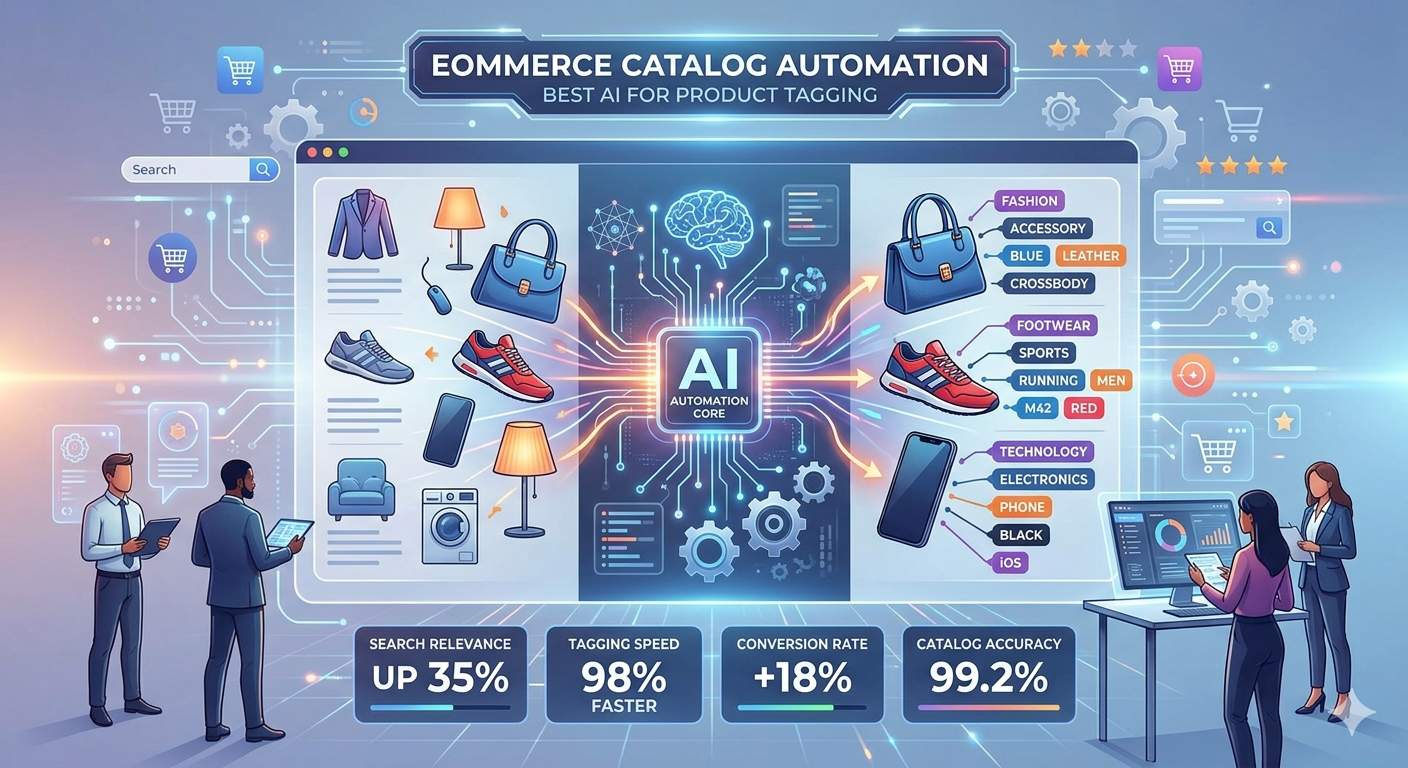
In the hyper-competitive digital marketplace, the efficiency of your catalog management directly influences your conversion rates. Modern online retail operations live and die by data structure; however, manual classification is slow, expensive, and riddled with human inconsistency. When shoppers use your on-site search, they expect precise results, fluid faceted navigation, and smart recommendations. If your metadata is incomplete, your items remain invisible.
Automating this workflow through machine learning is no longer a futuristic luxury it is a baseline operational requirement. Implementing the best ai to automate product tagging in ecommerce transforms unstructured visual and textual data into rich, searchable attribute profiles. This definitive guide evaluates the premier artificial intelligence solutions available to scale your catalog operations, improve discoverability, and maximize search engine performance.
The Operational Cost of Manual Data Entry
Traditional manual indexing cannot keep pace with dynamic inventory cycles and rapid seasonal product drops. Relying on human cataloging teams creates structural bottlenecks that delay time-to-market and impact your bottom line.
- Inconsistent Taxonomy: Different internal team members describe identical features using varying terminologies, splitting your filters.
- Prohibitive Scaling Expenses: As your stock-keeping unit (SKU) count expands into thousands, payroll costs for manual categorization scale linearly.
- Delayed Product Launches: New arrivals sit in storage or drafts because staff are manually extracting attributes, missing critical sales windows.
How AI Visual Recognition Decodes Merchandise
Computer vision models process digital imagery to identify technical attributes, patterns, silhouettes, and fabric textures instantly. This structural analysis generates deep metadata profiles without requiring human eyes.
- Silhouette and Cut Analysis: Algorithms immediately recognize design elements like neckline styles, sleeve lengths, or hem drops.
- Color and Pattern Extraction: Advanced pixel calculation extracts exact hex codes, dominant hues, and complex textile patterns.
- Automated Alt-Text Generation: Image analysis creates descriptive, accessible text strings that significantly improve Google Images visibility.
Deep Text Enrichment and Sentiment Parsing
Locating the best ai to automate product tagging in ecommerce involves analyzing written assets alongside imagery. Natural Language Understanding (NLU) systems extract structural data from supply chain spec sheets and customer text.
- Technical Spec Harmonization: Deep learning models parse chaotic raw supplier data to isolate dimensions, materials, and compliance metrics.
- Review Content Harvesting: Semantic analysis monitors buyer reviews to extract real-world usage keywords and colloquial descriptors.
- SEO Context Generation: Text intelligence maps raw feature lists into search-friendly terminology that mirrors actual user search trends.
Evaluating the Leading Enterprise Solutions
Selecting an operational platform requires balancing your existing technical architecture against catalog complexity. The dominant enterprise systems approach automated tagging from distinct structural angles.
Zoovu
Zoovu specializes in turning unstructured catalog descriptions into contextual semantic data layers. It bridges the gap between complex engineering specifications and human search patterns.
ViSenze
A pioneer in computer vision, ViSenze focuses heavily on visual search and automated visual attribute extraction. It is widely used by global fashion and home decor brands.
Google Cloud Vision & Amazon Rekognition
These foundational API engines provide massive, pre-trained visual recognition frameworks. They offer exceptional scalability for general merchandise categories with minimal initial training.
Comparing the Top AI Product Tagging Platforms
| Platform | Core Technology | Primary Advantage | Target Industry |
| Zoovu | Semantic NLU & Ontology | Deep attribute enrichment | Electronics, Industrial, Complex Retail |
| ViSenze | Advanced Computer Vision | Visual search & fashion precision | Fashion, Apparel, Home Furnishing |
| Google Cloud Vision | General Object Recognition | Highly scalable infrastructure | Broad Market Marketplaces, General Retail |
| Omnious.ai | Specialized Retail Vision | 95%+ Fashion attribute mapping | Specialized Apparel Brands, Footwear |
Enhancing On-Site Search and Guided Discovery
Accurate metadata directly fuels your internal search engines, eliminating empty search results pages. When product attributes match customer intent, average order value (AOV) increases.
- Expanded Faceted Navigation: Rich metadata automatically populates deep sidebar filter options, letting users narrow searches by micro-attributes.
- Semantic Query Matching: Computer-generated tags allow systems like Algolia or Constructor to comprehend conversational search intent.
- Dynamic Merchandising: Merchandising systems use granular classification metadata to display highly accurate cross-sell recommendations.
Driving Organic Visibility with Semantic SEO
Search engines rely heavily on clean structural data to properly index and rank e-commerce product pages. Automated data enrichment guarantees your collection pages speak the exact language search engines prefer.
- Schema Markup Automation: Rich attribute data automatically structures your JSON-LD schema, winning Google Rich Snippets.
- Long-Tail Keyword Capture: Automated attribute extraction naturally seeds long-tail search terms across your programmatic landing pages.
- Reduced Internal Keyword Cannibalization: Distinct, precise tag profiles help search engines differentiate between highly similar product variants.
Machine Learning Integration Strategies
Deploying automated asset tracking into your operational pipeline requires choosing an implementation architecture that matches your internal technical capabilities.
Headless API Connections
Direct programmatic integration via REST or GraphQL APIs allows enterprise systems to process assets instantly upon ingestion into your Product Information Management (PIM) system.
Spreadsheet Workflow Systems
For mid-market brands, AI automation toolsets like Numerous run deep learning models directly within enterprise spreadsheets, offering accessible bulk execution without developer overhead.
Mitigating Risk with Algorithmic Data Cleaning
Inconsistent data from supplier data feeds corrupts site taxonomy and degrades the shopping experience. Machine learning addresses this by standardizing entries prior to storefront publication.
- Format Unification: Systems automatically rewrite inconsistent strings (e.g., converting “8 ounces,” “8 oz,” and “0.5 lbs”) into standard formats.
- Taxonomy Alignment: Machine intelligence remaps non-standard vendor terms into your established global store taxonomy.
- Duplication and Error Scans: Intelligent validation detects overlapping entries or contradictory attributes before they go live.
Case Study: Optimizing a High-Volume Fashion Enterprise
An international fashion marketplace managing more than 150,000 active SKUs replaced their external manual data entry agency with a specialized computer vision tagging engine.
- Throughput Velocity: Time-to-market for weekly product drops decreased from 48 hours to less than 15 minutes.
- Tagging Quality Improvements: Overall attribute granularity increased by 400% per item, exposing deeper filtering options.
- Conversion Impact: Enhanced internal search relevance and expanded sidebar filters led to a measured 14% increase in site-wide conversion rate.
Calculating Your Automation Return on Investment
Transitioning to automated classification requires upfront capital but yields significant compounding operational savings over time.
- Direct Payroll Reductions: Software fees replace the recurring hourly costs of manual internal or outsourced data entry teams.
- Accelerated Capital Velocity: Reducing time-to-market means inventory transitions from warehouse arrival to revenue generation much faster.
- Reduced Cart Abandonment: Eliminating zero-result search errors keeps frustrated buyers from bouncing to competitors.
Elevating Personalization and Recommendation Engines
Modern personalization platforms require granular product data to build accurate contextual user interest profiles.
- Hyper-Specific Cohort Tracking: Tracking exactly which attributes a user clicks reveals subtle stylistic preferences beyond basic categories.
- Precise Predictive Cross-Selling: Systems can recommend items featuring identical subtle attributes (like matching tortoiseshell buttons).
- Dynamic Email Personalization: Automated triggers populate post-purchase workflows with items matching the exact technical profile of previous orders.
Scaling Global Catalogs with Automated Translation
Enterprise internationalization introduces localized nomenclature challenges that manual translation groups struggle to manage efficiently.
- Cross-Border Taxonomy Alignment: Localization algorithms map structured attribute concepts to appropriate cultural shopping phrases, avoiding literal translation errors.
- Automated Multilingual Feeds: Systems simultaneously translate and optimize product tag profiles for global marketplaces like Amazon, Mercado Libre, and Baidu.
- Localized Search Consistency: Overseas shoppers find products using local dialects because the underlying metadata accommodates regional search variations.
The Evolution of Catalog Automation Architecture
The underlying technology supporting digital inventory management continues to transition from rigid pattern matching toward flexible context processing.
- Generative Tagging Innovation: Modern multi-modal systems analyze text and imagery together, writing creative yet accurate tags.
- Zero-Shot Transfer Capabilities: Advanced foundational models categorize unique, highly specialized items without requiring extensive training sets.
- Edge Processing Integration: Future data ecosystems will execute computer vision pipelines directly on mobile devices during factory photography.
Architectural Principles for Choosing Your Toolset
Finding the right system for your brand depends directly on catalog composition, volume, and internal technical resources.
Frequently Asked Questions
What is automated product tagging in e-commerce?
Automated product tagging uses artificial intelligence, computer vision, and natural language processing to automatically extract and assign descriptive attributes (such as color, material, style, and technical specs) to items in an online catalog. This replaces manual data entry.
How does computer vision improve catalog data accuracy?
Computer vision scans product images at a pixel level to identify patterns, silhouettes, textures, and shapes. It applies tags based on visual evidence, which eliminates human bias and ensures every item is categorized using a unified corporate standard.
Can AI tagging software integrate directly with Shopify or Adobe Commerce?
Yes, many enterprise tools offer native applications or pre-built connectors for major platforms. More complex or proprietary setups connect via developer-friendly REST or GraphQL APIs to inject metadata directly into your PIM or ERP system.
Does automated catalog enrichment improve Google rankings?
Absolutely. By enriching your product listings with highly granular, accurate attributes, you naturally populate your page source with long-tail keywords. It also provides the structured data needed to generate high-ranking Google Rich Snippets.
What is the typical accuracy rate of retail machine learning models?
Leading specialized retail computer vision models deliver an initial out-of-the-box accuracy rate between 90% and 95%. These platforms continue to improve over time as they learn from your manual approvals and corrections.
How does structured product metadata lower bounce rates?
When your product tags are accurate and detailed, your internal search engine functions properly. Shoppers find exactly what they are looking for through search boxes and sidebar filters, reducing the friction that causes them to leave your site.
Is AI product tagging cost-effective for mid-sized online stores?
Yes, because it scales efficiently. While enterprise systems require custom quotes, spreadsheet-integrated AI tools and mid-market applications allow growing brands to automate thousands of SKUs for a predictable, nominal monthly technology fee.
Actionable Next Steps for Retail Operators
Transitioning your catalog management to machine learning is a straightforward process when executed in logical operational phases. Begin by auditing your existing storefront search metrics to identify search terms that yield zero results; this reveals the gaps in your current manual metadata taxonomy. Next, select a pilot collection such as a single challenging brand or a high-volume seasonal category to run through a trial with a spreadsheet automation tool or a platform demo.
Once you establish a standardized corporate dictionary and verify the accuracy of the algorithmic outputs, connect the platform directly to your primary Product Information Management system. Automating this foundational layer optimizes your operational workflow, ensures your products are easily discoverable, and positions your business to scale effortlessly as consumer search behavior evolves.